Selling a DDA or Society Flat in Dwarka: Circle Rate, TDS and Capital Gains Tax (2026)
When you sell a DDA or society flat in Dwarka, tax turns on three numbers: the circle-rate value of the flat, the price you get, and what you paid for it. If the circle-rate value is more than 110% of your price, the tax department uses the circle-rate value. The buyer deducts 1% TDS if either figure is ₹50 lakh or more. If you bought before 23 July 2024, you pay the lower of 12.5% on the plain gain or 20% on the indexed gain, and you can cut that to nil by buying another house or investing in specified bonds. This guide applies the Income-tax Act, 2025, in force from 1 April 2026, to a typical Dwarka sale.
Step 1: the circle-rate check
Delhi still uses the circle rates notified with effect from 23 September 2014. A committee set up in October 2025 is reviewing them, but no new residential rates had been notified by October 2026. Flats in DDA and group-housing buildings are not valued on the colony’s land rate. They are valued on plinth area, with an age factor applied. The 2014 rates for such flats, as published, are below.
| Plinth area of the flat | Rate per sq m (2014 notification, before the age factor) |
|---|---|
| Up to 30 sq m | ₹50,400 |
| 30 to 50 sq m | ₹54,480 |
| 50 to 100 sq m | ₹66,240 |
| Above 100 sq m | ₹76,200 |
| Flats in buildings of more than four storeys | ₹87,840 |
Section 78 of the Income-tax Act, 2025 (the old section 50C) says that if this stamp duty value is more than 110% of your sale price, the stamp duty value is treated as your sale price. If you agreed the price earlier and took part payment by bank transfer or cheque on or before the agreement date, the value on the agreement date can be used. If you think the circle-rate value is higher than the flat’s real worth, you can ask for a reference to a Valuation Officer. In most Dwarka sales the market price is well above the 2014 rates, so this rule rarely bites, but check it for small or old flats.
Step 2: TDS by the buyer
- 1% TDS applies under section 393(1) of the 2025 Act (the old section 194-IA) where the price or the stamp duty value is ₹50 lakh or more. It is 1% of the higher of the two, and the price is counted across all buyers and all sellers together.
- The buyer files and pays on Form 141 (which replaces Form 26QB from Tax Year 2026-27) within 30 days from the end of the month of deduction, using PAN; no TAN is needed. Each buyer files for his own share.
- You get a certificate in Form 132 (which replaces Form 16B), downloaded by the buyer from TRACES. Check that the TDS shows in your Form 26AS and AIS before you file.
- Selling as a non-resident? The buyer deducts tax at the rates in force on long-term gains plus surcharge and cess, not 1%, and needs a TAN. Apply for a lower deduction certificate in Form 128 (which replaces Form 13) before the sale, so that tax is deducted only on the gain.
Step 3: work out the capital gain
A flat held for more than 24 months is a long-term asset. The rate is 12.5% without indexation. If you are a resident individual or HUF and bought the flat before 23 July 2024, section 197(3) caps the tax at what you would pay at 20% with indexation, so in effect you pay the lower of the two.
A worked example
You bought a Dwarka flat in 2010-11 for ₹30 lakh and sell it in November 2026 for ₹1.20 crore. The Cost Inflation Index is 167 for 2010-11 and 384 for 2026-27.
| 12.5%, no indexation | 20%, with indexation | |
|---|---|---|
| Cost | ₹30,00,000 | ₹30,00,000 × 384 ÷ 167 = ₹68,98,204 |
| Gain | ₹90,00,000 | ₹51,01,796 |
| Tax before surcharge and cess | ₹11,25,000 | ₹10,20,359 |
Here the indexed route saves about ₹1 lakh. For flats bought recently, or where prices rose fast, the 12.5% route usually wins. Add the cost of improvements, such as a new floor or kitchen with bills, and the brokerage and legal fees on the sale, before you compare.
Step 4: the two exemptions
| Route | What you do | Limits |
|---|---|---|
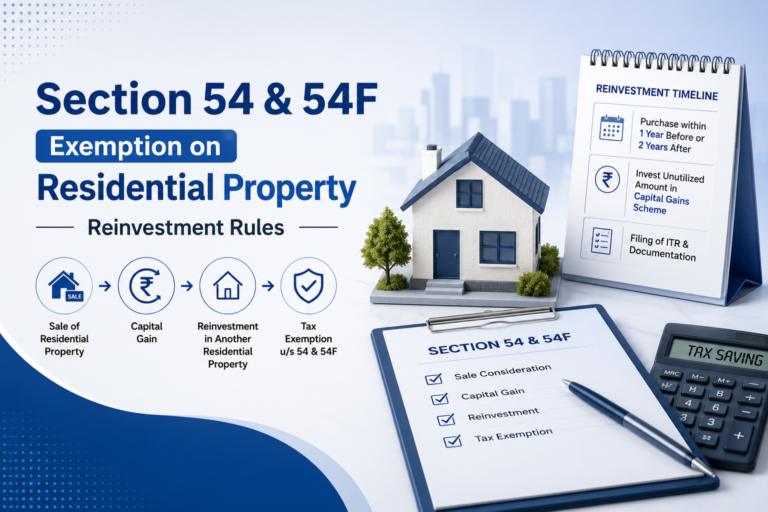
| Buy another house, section 82 (old section 54) | Buy a house in India 1 year before or 2 years after the sale, or build one within 3 years | Cost above ₹10 crore is ignored; two houses allowed once in a lifetime if the gain is ₹2 crore or less |
| Specified bonds, section 85 (old section 54EC) | Invest in NHAI, REC or other notified bonds within 6 months of the sale | Up to ₹50 lakh; locked in for 5 years |
If you plan to buy a house but have not done so by the return due date, deposit the unused gain in the specified bank deposit scheme before you file. Otherwise the exemption is lost even if you buy later.
DDA flats: freehold, GPA and the 2026 position
- Conversion is optional. A leasehold DDA flat can be sold, and the buyer can convert it to freehold later. Many buyers and banks still prefer a freehold title, so conversion often decides the price.
- The conversion portal has been shut in 2026. In September 2026 the Delhi High Court ordered DDA to decide 1,373 pending conversion applications within two months, at the charges in force when each was filed. Any new conversion policy will apply only to future cases.
- GPA chains do not pass title. The Supreme Court held in Suraj Lamps (2011), and reaffirmed in 2023, that an agreement to sell, GPA or will does not transfer ownership. If you bought on GPA, regularise the chain before you sell, or the buyer’s bank will refuse the loan.
The department will see the sale
The sub-registrar reports every sale or purchase of ₹30 lakh or more to the Income Tax Department, and it shows in your Annual Information Statement with the buyer’s TDS. Report the sale in your return even if the gain is fully exempt; a mismatch with the AIS brings a notice.
Checklist before you sign
- Find your original purchase deed, conversion letter if any, and bills for improvements.
- Work out the circle-rate value and compare it with the offer.
- Compute tax both ways and decide whether to reinvest.
- Give the buyer your PAN and check the TDS in Form 26AS within two months.
- If you are an NRI, apply for the lower deduction certificate before you sign the agreement.
Frequently asked questions
Is indexation still available on property sold in 2026?
Yes, for resident individuals and HUFs who bought before 23 July 2024: the tax is capped at 20% with indexation, so you pay the lower figure. Otherwise the rate is 12.5% without indexation.
Who deducts TDS when I sell my flat?
The buyer, at 1% of the higher of the price and the stamp duty value, if either is ₹50 lakh or more. A non-resident seller faces TDS at the capital gains rate unless he has a lower deduction certificate.
Has Delhi revised its circle rates in 2026?
Not for flats, as of October 2026. The 2014 rates still apply, and a government committee is reviewing them.
Our Dwarka office handles property sale computations, lower deduction certificates and capital gains returns for owners across Dwarka, Palam, Janakpuri and the rest of Delhi. See our capital gains tax filing service, the TDS on property sale service, or talk to our Delhi team.
Last updated 26 October 2026. Sources: Income-tax Act, 2025, sections 78, 82, 85, 197 and 393; Income Tax Department FAQs on Forms 128, 132 and 141; CBDT notifications of the Cost Inflation Index for 2025-26 (376) and 2026-27 (384); Delhi Revenue Department circle rate notification effective 23 September 2014; Delhi High Court order of September 2026 on pending DDA freehold conversions; Suraj Lamps and Industries v. State of Haryana (2011); Income Tax Department guidance on reporting of high-value transactions. General information only; circle-rate figures should be confirmed for your property before you rely on them.