
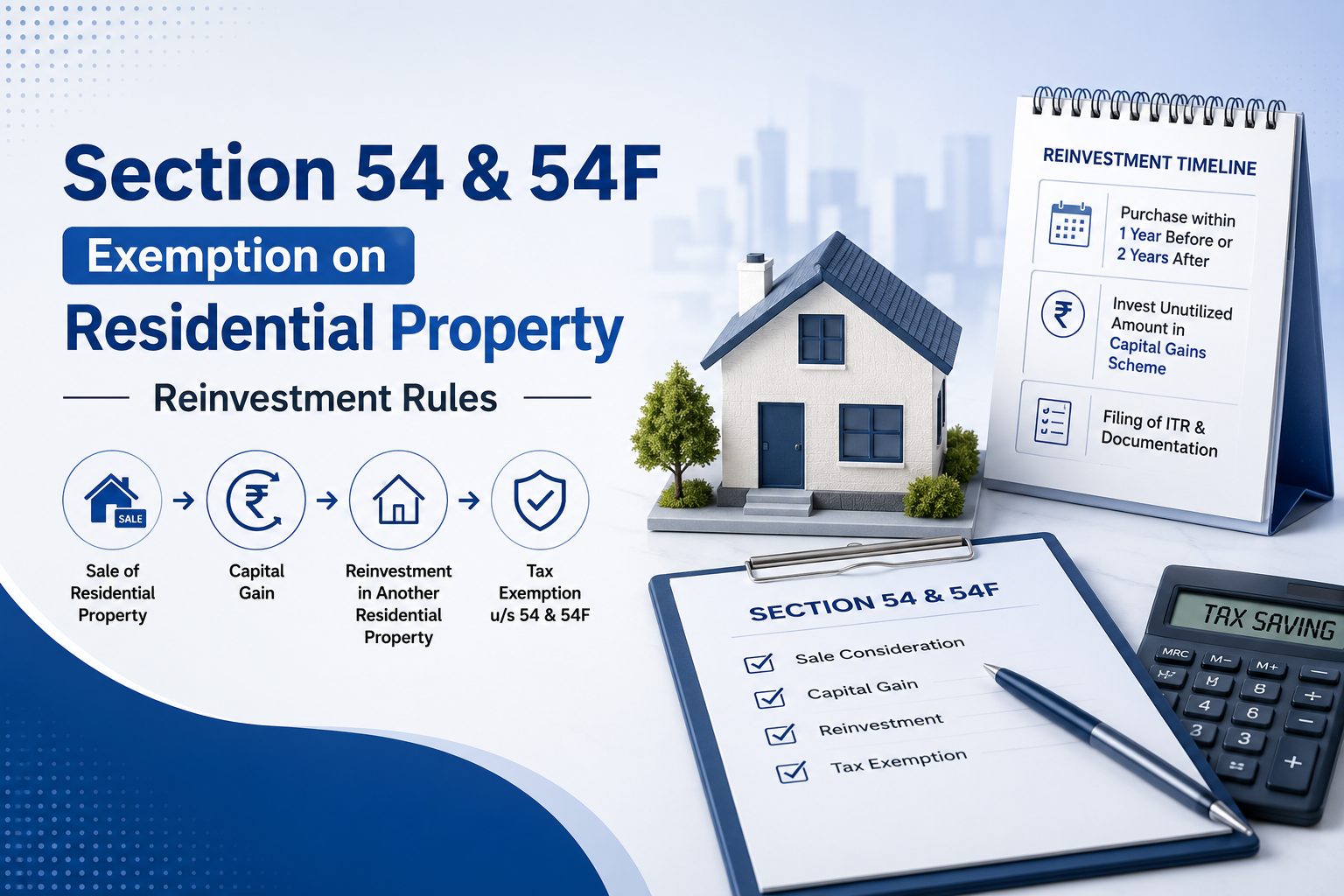
Section 54 & 54F Exemption on Residential Property — Reinvestment Rules
Introduction
Selling a property often results in Long-Term Capital Gains (LTCG), which may attract income tax. However, the Income-tax Act provides valuable relief through Section 54 and Section 54F, allowing eligible taxpayers to claim exemption by reinvesting in a residential property.
Understanding the difference between these provisions and complying with the prescribed timelines can help taxpayers legally reduce or even eliminate their capital gains tax liability. The Income Tax Department’s guidance reflects the latest amendments, including the ₹10 crore cap on eligible investment for exemption.
What is Section 54?
Section 54 applies when an individual or HUF sells a long-term residential house property and reinvests the capital gains in another residential house situated in India. The exemption is available subject to specified conditions regarding purchase, construction, and timelines.
Key Features
- Applicable only on the sale of a long-term residential house.
- Investment must be made in a residential house located in India.
- Exemption is generally available for one residential house. In specified cases where long-term capital gains do not exceed ₹2 crore, a one-time lifetime option exists to invest in two residential houses.
What is Section 54F?
Section 54F applies when a taxpayer sells any long-term capital asset other than a residential house (such as land or shares) and invests the net sale consideration in a residential house in India.
Unlike Section 54, the exemption under Section 54F is generally proportionate if the entire net consideration is not reinvested, and additional eligibility conditions apply, including restrictions on owning multiple residential houses.
Reinvestment Timelines
To claim exemption under either section, the new residential property must be:
- Purchased within one year before the date of transfer, or
- Purchased within two years after the date of transfer, or
- Constructed within three years from the date of transfer.
Meeting these timelines is one of the most important conditions for claiming the exemption.
Capital Gains Account Scheme (CGAS)
If the taxpayer is unable to purchase or construct the new house before the due date for filing the income tax return, the unutilized amount should generally be deposited in the Capital Gains Account Scheme (CGAS) before the applicable return filing due date.
The deposited amount must subsequently be utilized within the prescribed purchase or construction period. If it remains unutilized, it becomes taxable in the year in which the prescribed period expires.
Important Conditions to Remember
Before claiming exemption, keep these points in mind:
- The new residential property must be situated in India.
- The eligible investment for exemption is subject to a maximum limit of ₹10 crore under the current provisions.
- The new property should generally not be transferred within the prescribed lock-in period, failing which the earlier exemption may be withdrawn as per the Act.
- Maintain proper documentation, including purchase deeds, construction records, payment proofs, and CGAS deposit receipts (where applicable).
Section 54 vs Section 54F – Quick Comparison
| Particular | Section 54 | Section 54F |
|---|---|---|
| Original Asset Sold | Long-term residential house | Any long-term capital asset (except residential house) |
| Investment | Capital gains | Net sale consideration |
| New Asset | Residential house in India | Residential house in India |
| Eligible Taxpayer | Individual or HUF | Individual or HUF |
| Partial Investment | Exemption based on eligible capital gains invested | Proportionate exemption if entire net consideration is not invested |
Common Mistakes to Avoid
- Missing the statutory investment timelines.
- Failing to deposit the unutilized amount in the Capital Gains Account Scheme.
- Assuming every property sale automatically qualifies for exemption.
- Not maintaining documentary evidence for investment.
- Ignoring ownership conditions applicable under Section 54F.
Conclusion
Sections 54 and 54F offer significant opportunities to save capital gains tax, provided taxpayers carefully follow the prescribed reinvestment rules and documentation requirements. Whether selling a residential house or another long-term capital asset, timely planning and proper compliance can result in substantial tax savings while facilitating investment in a new home.
Given the complexity of capital gains taxation, professional advice is recommended before executing high-value property transactions.
📲 Stay Connected for More Tax & Compliance Insights
👉 Join our WhatsApp Channel for daily updates:
https://whatsapp.com/channel/0029VaAOrtiFCCoQlhtGIx2o
👉 Explore more informational content on our YouTube Channel:
https://www.youtube.com/@taxajca
📞 Reach out via Call or WhatsApp: +91 8802912345

Pooja Sarvang is a Company Secretary in TAXAJ's Accounts & Taxation team. With over six years of experience in corporate secretarial, governance and compliance matters, Pooja helps companies meet their statutory obligations under the Companies Act and allied laws. TAXAJ is a multi-disciplinary consulting firm spanning finance, taxation, legal, secretarial, FEMA and IPR, with offices in Delhi, Bihar, Bangalore and Goa.
View all posts by Pooja Sarvang →