
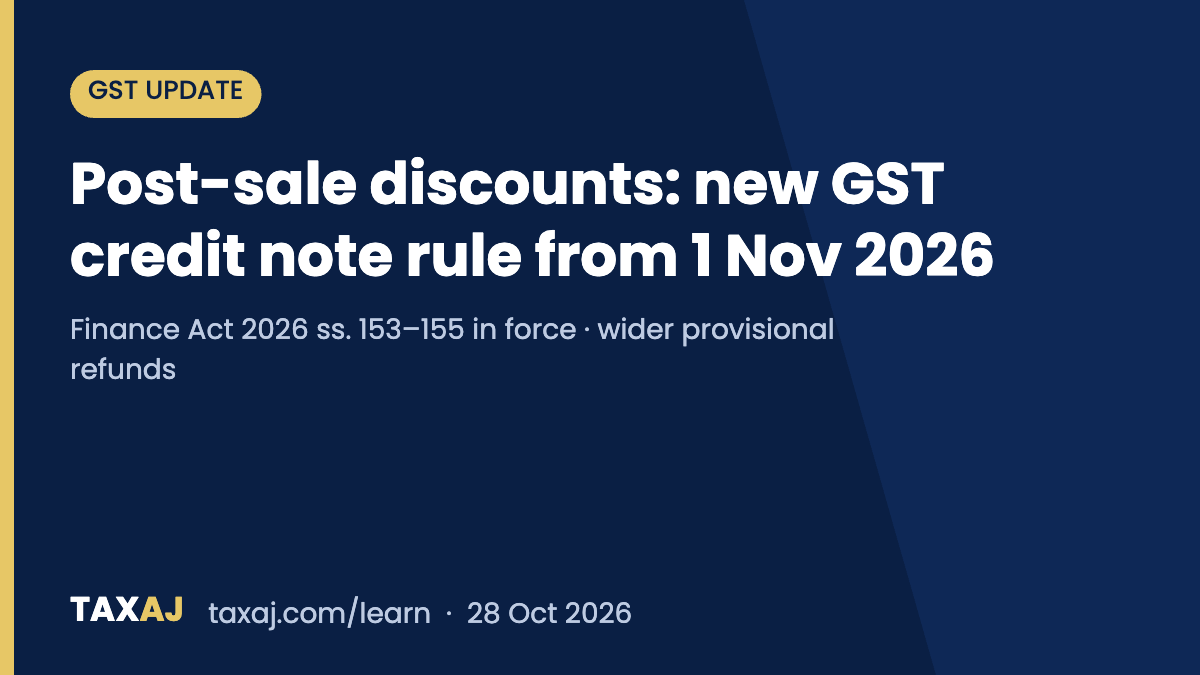
GST Post-Sale Discounts: Credit Note Route From 1 November 2026
From 1 November 2026, a discount given after a sale can reduce the GST value of that sale without having been agreed before the supply or linked to specific invoices — as long as the supplier issues a GST credit note and the buyer reverses the matching input tax credit. The change comes from sections 153 to 155 of the Finance Act, 2026, which CBIC brought into force by Notification No. 03/2026–Central Tax dated 26 October 2026. The same sections also widen provisional refunds and remove the ₹1,000 minimum for one class of export refund.
What changed
| CGST Act provision | Until 31 October 2026 | From 1 November 2026 |
|---|---|---|
| Section 15(3)(b) — post-supply discounts | Excluded from value only if established by an agreement made at or before the supply, specifically linked to the relevant invoices, and the buyer reversed the attributable ITC | Excluded if the supplier issues a credit note for the discount and the buyer reverses the attributable ITC, in accordance with section 34 |
| Section 34(1) — credit notes | Covered excess value or tax, goods returned and deficient supplies | Also covers a discount referred to in section 15(3)(b) |
| Section 54(6) — provisional refund | Available for refunds on zero-rated supplies | Also available for refund of unutilised ITC under clause (ii) of the first proviso to section 54(3) (inverted duty structure) |
| Section 54(14) — ₹1,000 minimum refund | Applied to refunds under section 54(5) or 54(6) | Does not apply where refund is claimed on goods exported out of India with payment of tax |
Who it affects
- Suppliers who give trade, volume, target or year-end discounts after the invoice — manufacturers, distributors and brands in FMCG, pharma, auto, electronics and similar trades. Many of these discounts were never agreed invoice by invoice, so they were often passed as commercial (financial) credit notes without reducing GST.
- Buyers who receive those discounts, because the value reduction now depends on them reversing the input tax credit attributable to the discount.
- Businesses with an inverted duty structure, whose ITC refunds now fall within the provisional refund route of section 54(6).
- Exporters of goods who pay IGST on exports and claim it back, including small claims that fell below the ₹1,000 floor.
How the refund side will work
Section 54(6) allows the proper officer to refund, on a provisional basis, 90 per cent of the amount claimed, with the balance settled after verification. Until now that route was used for zero-rated supplies; it now extends to inverted duty structure refunds. Separately, the CGST (Amendment) Rules, 2026 (Notification No. 05/2026–Central Tax, also dated 26 October 2026) substitute rule 91(2) so that the provisional refund order in FORM GST RFD-04 is generated by the common portal, on system-based risk evaluation, within three working days of the acknowledgement.
What it does not change
- Discounts shown on the invoice itself are still governed by section 15(3)(a) and are unaffected.
- The time limit for declaring a credit note in section 34(2) is not amended.
- The buyer’s ITC reversal remains a condition. A credit note the buyer does not act on will not by itself reduce the supplier’s value.
- The notification does not say how the new clause treats discounts on supplies made before 1 November 2026. Take advice before applying it to older invoices.
What to do now
- Review your discount schemes and decide which post-sale discounts you will now pass as GST credit notes instead of financial credit notes.
- Tell your buyers that GST credit notes will flow to them and that they must reverse the matching ITC; update your distributor agreements and reconciliation steps.
- Line up pending refunds: inverted duty structure claimants should expect the provisional refund route, and exporters with small IGST refunds below ₹1,000 can now claim them.
Need help with GST credit notes and refunds?
TAXAJ handles GST refund claims and GST return filing from offices in Delhi, Bengaluru, Goa and Bihar. For the wider reform context, see our note on GST 2.0 and the 57th Council reforms, and for every other change, our GST news and announcements page.
Source: CBIC Notification No. 03/2026–Central Tax dated 26 October 2026, read with sections 153 to 155 of the Finance Act, 2026 (No. 4 of 2026) and Notification No. 05/2026–Central Tax. Last updated 28 October 2026. This is general information, not advice on any particular case.
