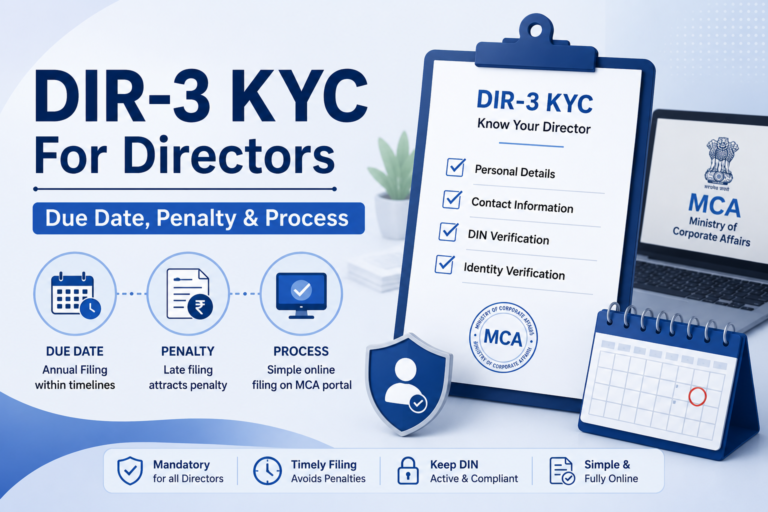
DIR-3 KYC 2026: Filing, Due Date and 3-Year Cycle
DIR-3 KYC is the annual (now periodic) verification that the Ministry of Corporate Affairs (MCA) requires from every person holding a Director Identification Number (DIN). It keeps the director database accurate and confirms that the individual behind each DIN is genuine and contactable. Following the 2025 amendment notified through G.S.R. 943(E), the compliance has moved from a yearly filing to a once-in-three-years cycle, and this article explains what the change means for directors and DIN holders in 2026.
What is DIR-3 KYC?
DIR-3 KYC is a filing through which a DIN holder confirms and updates the personal particulars linked to their DIN, such as name, nationality, date of birth, permanent account number (PAN), residential address, and a personally verified mobile number and email. The mobile number and email are authenticated through a one-time password (OTP), which is why the exercise is genuinely a “know your director” check rather than a routine form. The purpose is to weed out inactive or bogus DINs and to ensure the MCA can reach every director on record.
Who must file DIR-3 KYC?
The obligation applies to every individual who has been allotted a DIN on or before 31 March of the relevant financial year and whose DIN is in “Approved” status. It is important to note that the requirement is tied to the DIN, not to an active directorship. You must therefore file even if:
- you hold a DIN but are not currently a director in any company;
- you are a designated partner in an LLP holding a DIN;
- you have been disqualified as a director; or
- your DIN is dormant and unused.
In short, if a DIN was issued to you and it has not been surrendered or cancelled, the KYC obligation attaches to you.
The 2025 amendment: from annual to a three-year cycle
Historically, DIR-3 KYC was an annual compliance. Through the amendment notified under G.S.R. 943(E), effective 31 March 2026, the MCA has reduced the frequency to once every three consecutive financial years. The stated objective is to ease the compliance burden on directors while retaining the integrity of the DIN database. A director who completes the KYC for a given cycle is not required to file again until the next three-year point, provided none of their particulars change in the meantime.
One obligation, however, survives the relaxation. Any change in mobile number, email address, or residential address must still be reported to the MCA within 30 days of the change through the web-based process. Such a mid-cycle update does not reset or advance the three-year clock; the next periodic filing continues to fall due on schedule.
Due date for DIR-3 KYC
Under the earlier annual regime, the due date was 30 September of each financial year. Under the amended three-year framework, the filing is to be completed on or before 30 June of the relevant year in the cycle. Because the transition affects different DIN holders at different points, directors should confirm their specific due year with reference to when they last completed a valid KYC. As a rule of thumb, a person who filed for a particular financial year will next be required to file in the year following the third financial year of that cycle, on or before 30 June.
DIR-3 KYC Web versus DIR-3 KYC e-form
There are two routes through which the KYC can be completed, and choosing the correct one is essential.
DIR-3 KYC Web (OTP-based)
The web service is a simplified, OTP-based confirmation. It is meant for a DIN holder who has already filed a KYC in an earlier period and whose particulars remain entirely unchanged. The director logs in, the pre-filled details are displayed, and verification is completed by entering the OTPs sent to the registered mobile number and email. No documents or professional certification are needed, and there is nothing to alter.
DIR-3 KYC e-form
The e-form is required where the web route is not available, principally for a first-time filer (a DIN holder verifying particulars for the first time) or where any detail such as the mobile number, email, name, or address needs to be changed. The e-form must be filled with supporting documents, digitally signed with the director’s digital signature certificate (DSC), and certified by a practising professional (a chartered accountant, company secretary, or cost accountant). Once the e-form has been filed for a cycle, unchanged details in later cycles can typically be confirmed through the web service.
The amendment also moves the process toward a single, unified web-based experience for verification, but the underlying distinction remains practically relevant: unchanged, returning DIN holders confirm through OTP, while first-time filers and those with changes complete the fuller, document-backed and certified process.
Documents and details required
For the OTP-based web confirmation, no documents are uploaded; you only need access to the registered mobile number and email. Where the e-form applies, keep the following ready:
- DIN and personal details as per record (name, father’s name, date of birth, nationality);
- self-attested PAN card (for Indian nationals);
- self-attested Aadhaar card or, for foreign nationals, a passport (passport is mandatory for foreign directors);
- proof of present and permanent residential address, such as a recent utility bill or bank statement;
- a personal mobile number and personal email address for OTP verification;
- a valid digital signature certificate (DSC) of the director; and
- certification by a practising professional.
Fee and consequences of not filing
When DIR-3 KYC is completed within the due date, there is no government fee; the filing is free. If a DIN holder misses the due date, the DIN is marked as “Deactivated due to non-filing of DIR-3 KYC.” A deactivated DIN cannot be used to sign or submit filings, and the individual cannot be appointed or continue to act on the strength of that DIN until it is restored. Reactivation is possible only by completing the pending KYC together with a late fee of Rs 5,000. There is no way to reduce or waive this fee, so timely filing is always the cheaper course.
Frequently asked questions
Do I need to file DIR-3 KYC if I am not a director in any company?
Yes. The obligation follows the DIN, not the directorship. As long as you hold an approved DIN that has not been surrendered, you must complete the KYC even if you are not currently on any board.
I filed my KYC last year. Do I have to file again in 2026?
Not necessarily. Under the three-year cycle, once you have validly completed a KYC you are not required to file again until your next due year, unless your mobile, email, or address changes. Confirm your specific due year with reference to your last filing.
What is the difference between DIR-3 KYC Web and the e-form?
The web service is an OTP-based confirmation for returning DIN holders whose details are unchanged. The e-form is for first-time filers or where any particular needs to be updated, and it requires documents, a DSC, and professional certification.
My DIN has been deactivated for non-filing. Can I still fix it?
Yes. You can reactivate the DIN at any time by completing the pending DIR-3 KYC along with the Rs 5,000 late fee. Until then, the DIN remains unusable for appointments and filings.
Does updating my email or phone number reset the three-year cycle?
No. A mid-cycle update to your contact or address details must be reported within 30 days, but it does not change your next periodic due date.
If you are unsure of your due year, need to update your particulars, or want to reactivate a deactivated DIN, our team can manage the entire process end to end. TAXAJ regularly handles DIR-3 director KYC along with broader company and director compliance, so you stay on the right side of MCA deadlines without the paperwork. Reach out and we will confirm your status and file it correctly the first time.