How to Generate a UDIN: The Unique Document Identification Number
The attestation of a Chartered Accountant on a certificate or any such document is of immense value since it usually signifies that the Chartered Accountant, in his professional opinion, has ensured that there is no misrepresentation by the entity issuing/submitting such a document.
A prime example of this being an audit report issued by the auditor in respect of the financial statements of an entity stating the financial statements reflect a true and fair view of the state of affairs of the entity. It is because of this attestation or signature made by the Chartered Accountant that the investors and other stakeholders can rely on the performance of an entity.
UDIN, in one line
Unique Document Identification Number — an 18-digit number a practising Chartered Accountant generates on the ICAI portal and writes on a certificate, audit report or attestation. The first six digits are the member’s ICAI registration number; the rest is system-generated from the date and a security element.
What it proves is narrow and worth being precise about: that a particular member generated a number against a document of that description on that date. It is an authenticity marker, not an approval, a rating, or a guarantee of the numbers inside the document.
Someone gave you a document with a UDIN on it. How do you check it?
This is the more common reason to be reading about UDIN at all. A bank, a lender, a regulator, a buyer or a counterparty has been handed a certificate carrying an 18-digit number, and wants to know whether it is real.
ICAI runs a public verification facility. Anyone can use it — you do not need to be a member, and you do not need the CA’s permission.
- Go to the ICAI UDIN portal at udin.icai.org/search-udin.
- Enter the UDIN exactly as it appears on the document. You can also search on other particulars such as the firm registration number, a client reference code or the date of the document.
- Read what comes back against what you are holding: the date, the document type and the member. All three should match.
What a mismatch actually means. A UDIN that does not verify is not automatically a forgery — a transcription error, a transposed digit or a revoked number will all fail. But a number that does not exist, or that verifies against a different document type or date, is a reason to go back to the issuer before relying on the document. Treat it the way you would treat a signature you did not recognise.
Which documents need a UDIN, and who can generate one
Only a full-time practising Chartered Accountant holding a valid Certificate of Practice can generate a UDIN, and only through the ICAI portal after a one-time registration. It applies to certificates, audit reports and other documents certified or attested by the member — tax audit reports being the most familiar example.
A document signed by someone who is not a practising CA will not carry a UDIN, and should not be presented as if it does.
Introduction
It is being observed that certain unscrupulous individuals are forging signatures while posing as Chartered Accountants to issue certificates and other such documents with the intent of misleading the authorities.
In view of the above, the Institute of Chartered Accountants of India (ICAI), has developed a method of securing the documents issued by a Chartered Accountant by issuing a Unique Document Identification Number (UDIN). The official announcement is available on the ICAI website.
How to generate UDIN for a document?
The following steps need to be followed after registering on the UDIN portal:
Step 1: Go to the following link: https://udin.icai.org/?mode=myicai
Log in using the credentials received on the e-mail address registered with ICAI.
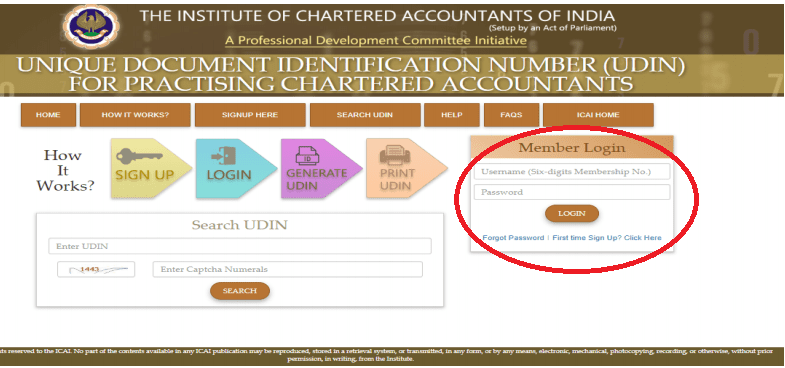
Note: The password for the UDIN portal can be changed at any time. It is recommended to do so after the first login.
Step 2: Click on ‘Generate UDIN’.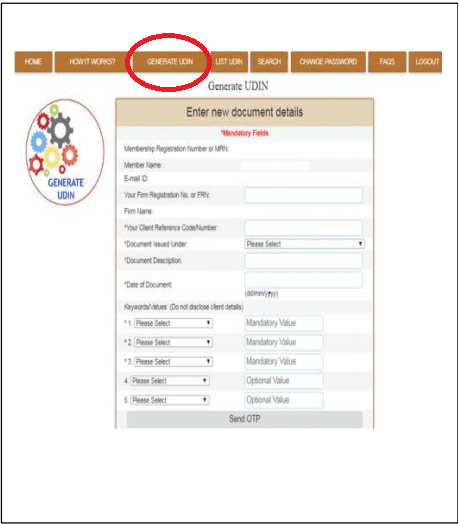
Step 3: Enter the required details such as Membership Registration Number, Name, E-mail ID, Firm Registration Number, Firm Name, Client Reference Code / Number, Document Description, Date of Document, Keywords and values and click on ‘Send OTP’.
The ‘keyword’ as mentioned above implies any keyword and its corresponding value / amount as contained in the document for which the UDIN is generated. For example, if the Chartered Accountant is certifying the turnover of an entity, one of the keywords could be ‘Turnover’ along with the corresponding turnover amount as its value.
Note that at least 3 keywords and their corresponding values need to be provided for a document. The maximum number of keywords that can be given are 5.
Step 4: The OTP will be sent on the e-mail address and mobile number registered with ICAI. After entering the OTP, a preview of the details entered will be available for verification. In case there are any changes in the details, press ‘Back’, else click on ‘Submit’.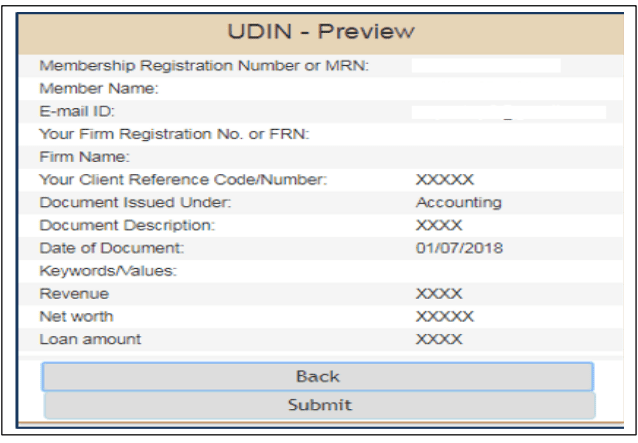
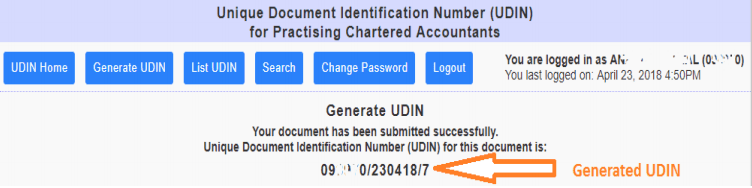
Step 5: The UDIN will now be generated. Such UDIN may be used on the document by mentioning it using a pen or as a watermark on the document.
Verification of Documents using UDIN
Once a UDIN for a particular document has been generated, the details of the document corresponding with the UDIN cannot be modified in any manner. However, there may be a situation where the document may either require certain changes or cancellation altogether. In such a situation, the UDIN may be revoked by searching for the document on the UDIN portal and clicking on ‘Revoke’.
Note that a reason for revocation will need to be provided. If the UDIN is searched for in the future, it will still appear on the portal, but the same would be displayed as ‘Revoked’.
Certificates you can rely on
If you have been given a certificate or attestation, the UDIN on it is what lets you verify it was genuinely issued. We issue certificates, attestations and reports with UDIN as a matter of course. See audit services, solvency certificates, and virtual CFO. Book a call.
Rules, thresholds and portal procedures change. This article is general information, not advice on a specific matter; please confirm the current position before acting.