
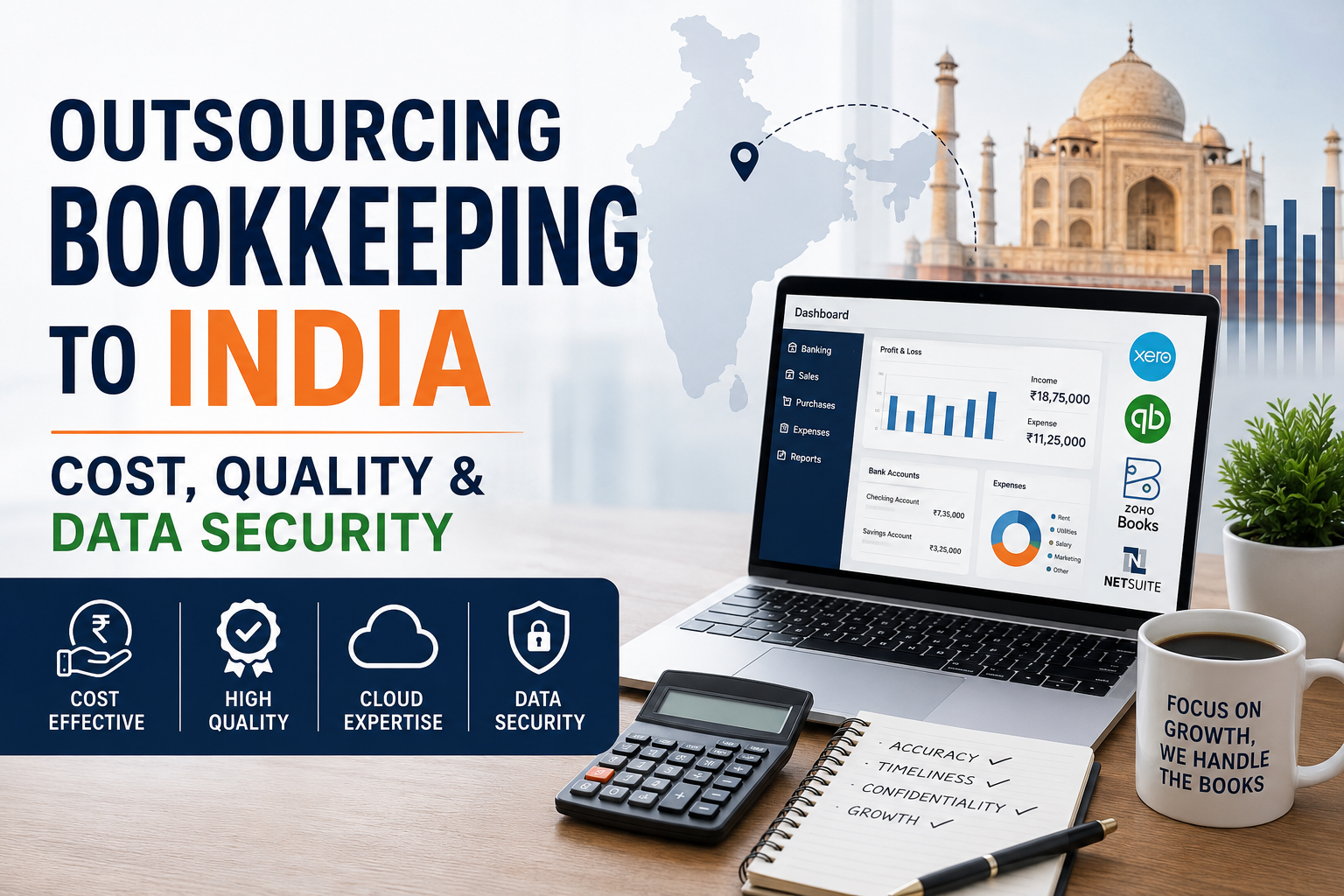
Outsourcing Bookkeeping to India – Cost, Quality & Data Security
Introduction
Managing books of accounts accurately is essential for every business, but maintaining an in-house accounting team can be expensive and time-consuming. This is why businesses across the US, UK, Canada, Australia, UAE, and many other countries are increasingly outsourcing bookkeeping to India. Beyond cost savings, companies gain access to experienced accounting professionals, modern cloud accounting solutions, and flexible support that grows with their business.
Why Businesses Choose India for Bookkeeping
India has become one of the world’s leading destinations for finance and accounting outsourcing. Businesses no longer outsource only to reduce costs—they also benefit from qualified professionals, faster turnaround times, and expertise in international accounting standards.
Many Indian bookkeeping firms work with popular accounting software such as QuickBooks Online, Xero, Zoho Books, NetSuite, Sage, and Microsoft Dynamics. Teams are often familiar with US GAAP, IFRS, and UK accounting practices, making it easier to support businesses operating in different countries.
Some of the most commonly outsourced bookkeeping functions include:
- Daily bookkeeping and transaction recording
- Bank and credit card reconciliations
- Accounts payable and receivable
- Payroll support
- Financial reports and management reporting
Is Outsourcing Really Cost-Effective?
Hiring an in-house bookkeeping team involves much more than salaries. Businesses also spend on recruitment, office infrastructure, employee benefits, software licences, training, and ongoing supervision.
Outsourcing converts many of these fixed costs into a flexible service model. Instead of hiring full-time staff, businesses pay only for the level of bookkeeping support they actually require. This approach is particularly beneficial for startups, SMEs, e-commerce businesses, and accounting firms experiencing seasonal workloads. Industry reports indicate that outsourcing to India can significantly reduce bookkeeping costs, although actual savings depend on the complexity and scope of work.
| In-House Team | Outsourced Team |
|---|---|
| Higher recruitment cost | No hiring required |
| Employee benefits | Service-based pricing |
| Office & infrastructure | Remote delivery |
| Fixed monthly overhead | Scalable as business grows |
| Limited capacity | Flexible resource allocation |
Does Outsourcing Affect Quality?
One of the biggest concerns businesses have is whether outsourcing compromises quality. In reality, the quality of bookkeeping depends more on the provider’s processes than on its location.
Established Indian accounting firms typically follow documented Standard Operating Procedures (SOPs), multi-level review systems, and regular quality checks to ensure accuracy. Many teams include Chartered Accountants (CAs) and professionals experienced in international accounting practices. Combined with cloud accounting software, these processes enable businesses to receive timely reports and well-maintained financial records.
Regular communication, defined workflows, and a dedicated point of contact also help businesses maintain complete visibility over their financial operations.
Is Your Financial Data Safe?
Data security is one of the most important factors when selecting an outsourcing partner. Reputable bookkeeping firms invest heavily in technology and security controls to protect sensitive financial information.
Common safeguards include:
- Non-Disclosure Agreements (NDAs)
- Multi-Factor Authentication (MFA)
- Encrypted file sharing
- Role-based access controls
- Secure cloud accounting platforms
- Regular data backups
- Audit logs and activity monitoring
Many established providers also align their security practices with recognised standards such as ISO 27001 or SOC 2, where applicable. Businesses should always verify the security measures followed by their outsourcing partner before sharing financial data.
Choosing the Right Bookkeeping Partner
Selecting the right outsourcing partner is as important as deciding to outsource itself. Rather than focusing only on pricing, businesses should evaluate the provider’s experience, communication process, software expertise, security controls, and client support.
Before signing an engagement, consider whether the firm:
- Has experience with your industry.
- Uses the accounting software you already work with.
- Provides regular financial reports.
- Follows documented review and quality processes.
- Has strong data security practices.
- Offers clear communication and dedicated support.
A transparent onboarding process and clearly defined responsibilities help ensure a smooth transition with minimal disruption to day-to-day operations.
Conclusion
Outsourcing bookkeeping to India has evolved from a cost-saving strategy into a practical business solution for companies seeking efficiency, scalability, and reliable financial management. With access to skilled professionals, modern cloud accounting tools, and strong data security practices, businesses can focus on growth while leaving routine bookkeeping to experienced experts. Choosing the right outsourcing partner ensures not only accurate books but also greater financial visibility and long-term operational efficiency.
📲 Stay Connected for More Insights
👉 Join our WhatsApp Channel
https://whatsapp.com/channel/0029VaAOrtiFCCoQlhtGIx2o
👉 Subscribe to our YouTube Channel
https://www.youtube.com/@taxajca
💬 Chat with Us on WhatsApp
https://wa.me/918802912345
🌐 Visit Our Website
https://www.taxaj.com
📞 Call Us
+91 8802912345

Amol Sinha is an Accounts Executive in TAXAJ's Accounts & Taxation team. With over six years of industry experience, Amol handles bookkeeping, tax filings and day-to-day compliance for clients. TAXAJ is a multi-disciplinary consulting firm spanning finance, taxation, legal, secretarial, FEMA and IPR, with offices in Delhi, Bihar, Bangalore and Goa.
View all posts by Amol Sinha →