
Which ITR Form Should You File? ITR-1 to ITR-7 Explained (AY 2026-27)
Picking the wrong ITR form is one of the easiest ways to turn a straightforward filing into a defective return notice. The income tax department prescribes seven forms, and each one is tied to a specific combination of taxpayer status and income types — not to how complicated your finances feel. File on a form that does not permit one of your income heads and the return is treated as defective, which means re-filing, a fresh verification, and in some cases losing the benefit of the original filing date. This guide walks through ITR-1 to ITR-7 for assessment year 2026-27 and gives you a decision path to land on the right one.
Start with two questions
Before looking at the forms, settle two things. First, what is your status — individual, HUF, firm, LLP, company, trust or AOP/BOI? Second, what heads of income do you have — salary, house property, business or profession, capital gains, or other sources? Almost every form choice falls out of those two answers. Add residential status as a third filter, because several simplified forms are available only to residents. If you want the filing handled end to end, TAXAJ’s income tax return filing service covers form selection, computation and e-verification.
ITR-1 (Sahaj) — the simplest case
ITR-1 is for a resident and ordinarily resident individual with income from salary or pension, one house property, and other sources such as bank interest, where total income is within the prescribed ceiling for the form. Limited long-term capital gains from listed equity and equity mutual funds are permitted within a specified cap. You cannot use ITR-1 if you are a director in a company, hold unlisted equity shares, have any business or professional income, own more than one house property, have foreign income or foreign assets, or have agricultural income above the small prescribed limit. Salaried filers whose only complexity is a second savings account belong here.
ITR-2 — individuals and HUFs without business income
ITR-2 is the workhorse for individuals and HUFs who are not carrying on a business or profession. Use it if you have capital gains beyond what ITR-1 permits, more than one house property, foreign assets or foreign income, income as a director or from unlisted shares, or you are a non-resident or resident but not ordinarily resident. Anyone who sold property or a meaningful equity portfolio during the year will typically file ITR-2 rather than ITR-1.
ITR-3 — business and professional income
ITR-3 applies to individuals and HUFs carrying on a proprietary business or profession, including partners drawing remuneration or interest from a firm. It accommodates every head of income, so a consultant with salary from part of the year, professional receipts, capital gains and rental income files a single ITR-3. It also requires a balance sheet and profit and loss statement, and where turnover or receipts cross the audit thresholds, an audit report has to be filed before the return.
ITR-4 (Sugam) — presumptive taxation
ITR-4 is for resident individuals, HUFs and firms other than LLPs who compute income on a presumptive basis under the small business or professional presumptive schemes, subject to the prescribed turnover and receipt limits for those schemes. It is deliberately short — no balance sheet, no detailed profit and loss. The exclusions mirror ITR-1: no directorships, no unlisted shares, no foreign assets, and no more than one house property. If your receipts cross the presumptive ceiling or you want to declare a lower profit than the deemed rate, you move to ITR-3 and into audit territory.
ITR-5 — firms, LLPs, AOPs and BOIs
ITR-5 covers partnership firms, limited liability partnerships, associations of persons, bodies of individuals, business trusts, investment funds, estates and similar entities. It does not apply to individuals, HUFs, companies or entities required to file ITR-7. If you are still deciding on structure, the trade-offs between an LLP and a company — including how each is assessed — are set out in our comparison of LLP versus private limited company.
ITR-6 — companies
ITR-6 is filed by every company other than one claiming exemption for income from property held for charitable or religious purposes. It must be filed electronically with a digital signature, and it sits alongside a company’s separate ROC filing obligations under the Companies Act. Those are a distinct compliance track with their own deadlines — see our guide to ROC annual filing for private limited companies.
ITR-7 — trusts, institutions and specified entities
ITR-7 is for persons required to furnish a return under the special provisions governing charitable and religious trusts, political parties, research associations, news agencies, universities, colleges and specified institutions. These filers have their own registration and audit prerequisites, and the return draws heavily on those registrations, so the underlying approvals must be current before filing.
A quick decision path
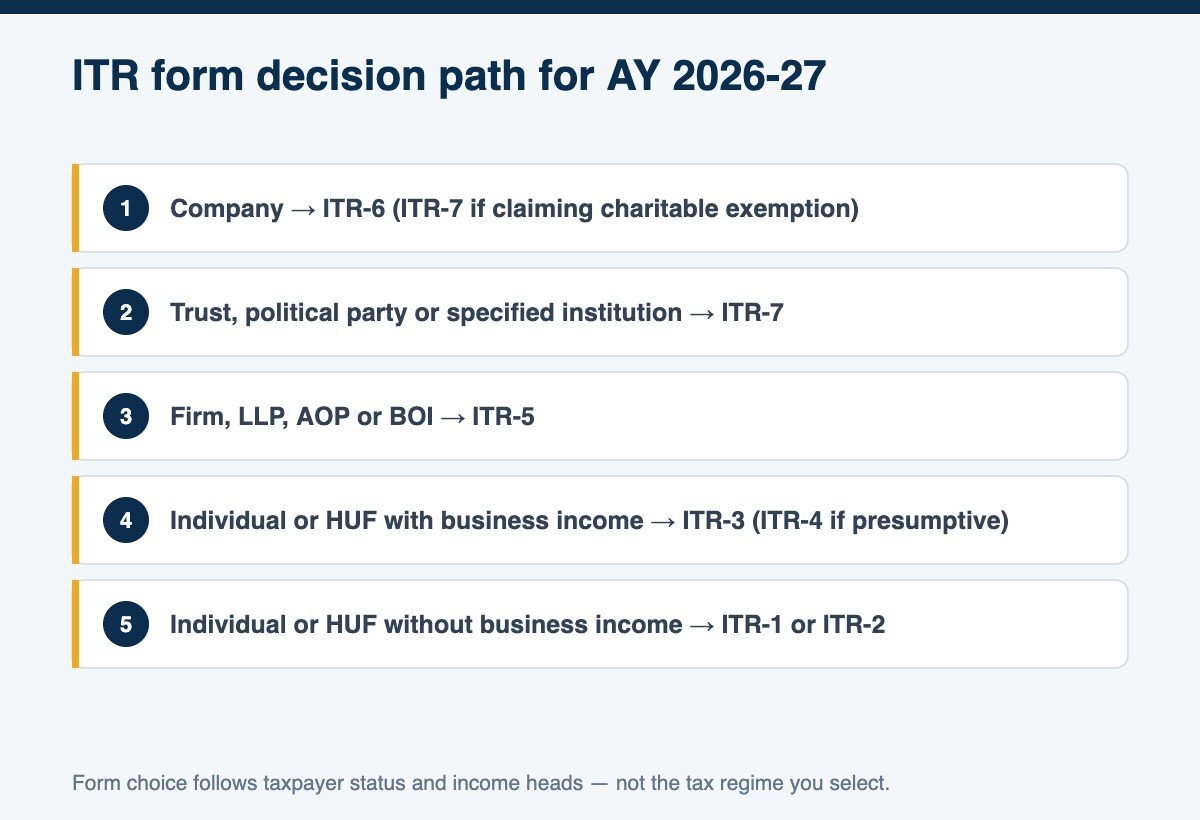
- Company? ITR-6, unless it is a charitable entity claiming exemption — then ITR-7.
- Trust, political party or specified institution? ITR-7.
- Firm, LLP, AOP or BOI? ITR-5, unless a small resident firm using presumptive taxation, which may use ITR-4.
- Individual or HUF with business or professional income? ITR-4 if presumptive and within the limits, otherwise ITR-3.
- Individual or HUF without business income? ITR-1 if resident, simple and within the ceiling; ITR-2 in every other case.
Before you file
Reconcile Form 26AS, the Annual Information Statement and the Taxpayer Information Summary against your own records first — mismatches on interest, dividend and high-value transactions are the most common trigger for follow-up queries. Confirm your regime choice, since it affects both your computation and, for business income, whether an option form is required. Finally, e-verify within the permitted window; an unverified return is treated as never filed. TAXAJ’s ITR filing team can review the data before submission if you would rather not do the reconciliation yourself.
Frequently asked questions
What happens if I file the wrong ITR form?
The return is likely to be treated as defective and you will receive a notice giving you a window to correct it. If you respond within the window with the right form, the original filing date is generally preserved; if you miss it, the return can be treated as invalid, which affects loss carry-forward and refund timing.
Can a salaried person with capital gains use ITR-1?
Only within a narrow allowance for long-term gains on listed equity and equity mutual funds, up to a specified cap. Any short-term equity gains, property gains, or long-term gains above the cap push you to ITR-2.
Which form should a freelancer or consultant use?
ITR-4 if you are a resident opting for presumptive taxation of professional receipts and stay within the scheme’s limits, otherwise ITR-3 with books, a balance sheet and a profit and loss statement.
Does the form change if I choose the old tax regime?
No — the form is driven by status and income heads, not by regime. The regime choice is a declaration made inside the return, though taxpayers with business income have an additional option-form requirement and a restriction on switching each year.
