
GST Rates 2026 — Full Slab List after GST 2.0
Getting the GST rate right is the difference between a clean invoice and a demand notice two years later. After the GST 2.0 rationalisation exercise, the slab structure was simplified considerably — fewer rates, clearer boundaries, and a separate treatment for demerit goods. This guide explains how the rate structure is organised in 2026, how to work out which slab your product or service falls into, and what to do when the classification is genuinely ambiguous. Because rates are revised at GST Council meetings and notifications can take effect mid-year, we point you to the live rate tool for the actual percentages rather than freezing figures in an article that will age.
How the GST rate structure is organised
Indian GST is a multi-rate system built around a small number of tiers rather than a single flat rate. Conceptually the structure has:
- A nil-rated and exempt category covering most unbranded staple foods, certain healthcare and education services, and specified essentials.
- A merit rate for mass-consumption goods and services where the policy intent is to keep the burden low.
- A standard rate that applies to the bulk of goods and most services by default when nothing more specific applies.
- A demerit or special rate for luxury items, tobacco, aerated beverages and similar categories, in some cases alongside a compensation-style levy.
- Special concessional rates for a narrow set of items such as bullion and rough precious stones, which sit outside the main tiers.
To see the current percentage attached to each of these tiers and what it does to a given invoice value, use the TAXAJ GST rate calculator, which is updated as notifications change.
Why the slab list is not the whole answer
Businesses often look for a single table and stop there. In practice the rate applicable to your supply depends on three things working together: the correct HSN code for goods or SAC code for services, the description in the relevant rate notification, and any conditions attached to that entry. Two products that look similar to a layperson — a plain biscuit and a chocolate-coated one, a hotel room at two different tariffs, a works contract for a government body versus a private client — can sit in different slabs entirely. The notification entry, not the commercial description, governs.
Finding the rate for your product or service
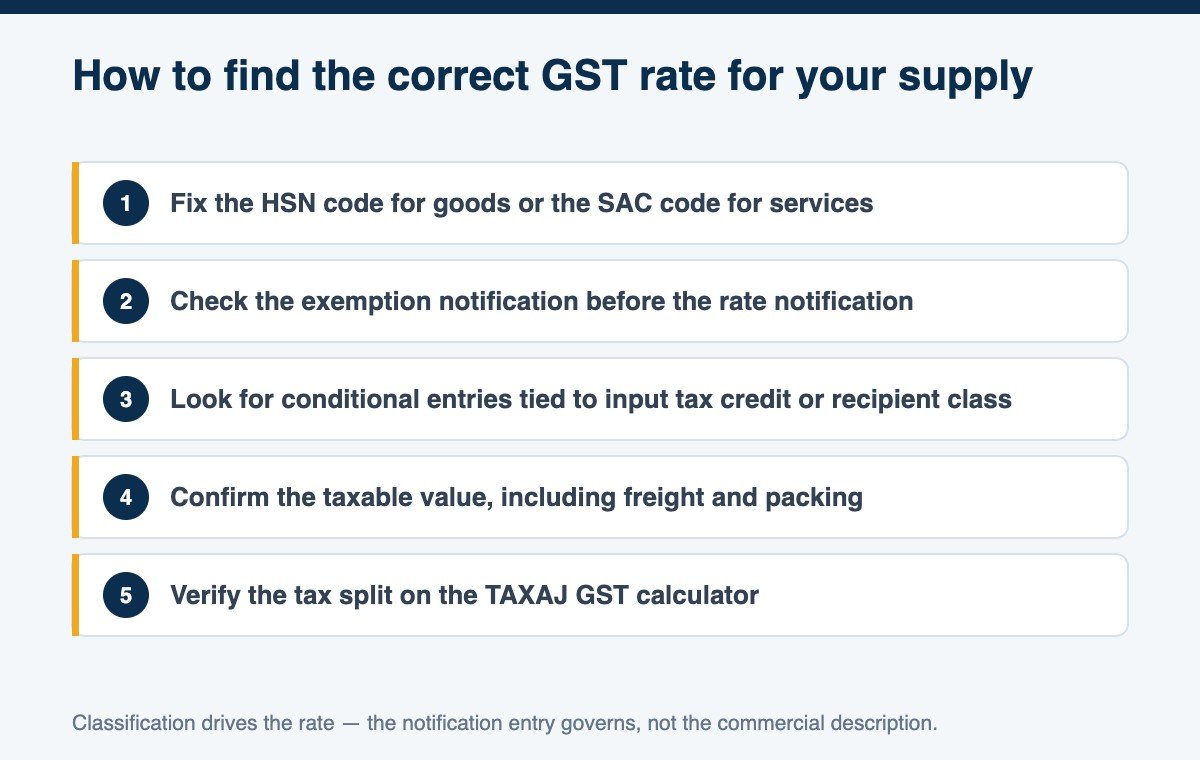
A reliable working method:
- Fix the HSN or SAC code first. Classification drives rate, not the other way round. Start from the chapter heading and narrow down to the eight-digit code.
- Check the exemption notification before the rate notification. If your supply is exempt, nothing else matters — but remember that exempt output means input credit has to be apportioned.
- Look for conditional entries. Several concessional rates apply only if input tax credit is not availed, or only to a specified class of recipient.
- Confirm the value on which the rate applies. Freight, packing, and reimbursements often form part of the taxable value.
- Run the transaction through the GST calculator to confirm the tax split between CGST, SGST and IGST once you know the place of supply.
Composite and mixed supplies
When you supply more than one thing together, the rate is not a blend. A composite supply — where the elements are naturally bundled and one is clearly principal, such as goods supplied with transport and insurance — takes the rate of the principal supply. A mixed supply — unrelated items sold together for a single price, such as a gift hamper — takes the highest rate among the components. Getting this distinction wrong on a recurring product line is one of the more expensive classification errors, because it repeats on every invoice.
Rate changes and which rate applies
When a rate is revised, the operative question is which rate applies to a transaction that straddles the change date. GST answers this through the time-of-supply provisions, which look at the interaction between the date of supply, the date of invoice and the date of payment. Where two of the three fall after the change, the new rate generally applies; where two fall before, the old rate does. Build this check into your process whenever the Council announces a revision, and re-issue price lists rather than assuming the ERP has picked up the change.
Reverse charge and rates
Certain supplies shift the liability to the recipient under reverse charge — goods transport agency services, legal services from advocates, sponsorship, imports of services, and specified supplies from unregistered persons. The rate is still determined by classification, but the person depositing the tax changes, and the recipient pays in cash rather than by using credit. If your business receives any of these regularly, the reverse charge working should sit alongside your rate master.
Rates, invoicing and returns
A correct rate is only useful if it flows through to your documents. Your tax invoice must carry the HSN or SAC code at the required digit level for your turnover band, the rate and amount of each tax head separately, and the place of supply for inter-state transactions. These fields then populate GSTR-1 and flow to your customer’s credit statement, so a rate error becomes their credit problem too. Our guide to GSTR-1 and GSTR-3B filing sets out how the returns connect, and if you are still setting up, start with the GST registration process.
When classification is genuinely unclear
Some products sit on a real boundary. Rather than picking the lower rate and hoping, document your reasoning contemporaneously: the competing entries, the technical characteristics of the product, and any tariff rulings or circulars you relied on. Where the amounts are significant and recurring, an advance ruling gives certainty for your own transactions. A well-documented position taken in good faith is treated very differently from an undocumented one.
Frequently asked questions
Where can I find the current GST rate for my product?
Start from the HSN code and check it against the live rate schedule. The TAXAJ GST calculator reflects the rates currently in force, which is safer than working from a rate table published at some point in the past.
What is the difference between nil-rated, exempt and zero-rated?
Nil-rated supplies attract a rate of zero under the schedule. Exempt supplies are notified as exempt. Both restrict input tax credit. Zero-rated is different — it applies to exports and supplies to SEZ units, and it preserves the right to claim or refund input credit, which is why exporters actively prefer it.
Do services and goods follow the same slabs?
They share the same tier structure but are notified separately, goods by HSN and services by SAC. A service is not automatically taxed at the standard rate; several service categories have their own concessional entries, often conditional on not claiming input credit.
Who decides GST rate changes?
The GST Council recommends rate changes, which are then given effect through Central and State notifications. Changes typically take effect from a specified date, so check the notification date rather than the announcement date when deciding which rate to charge.
