How to Start a Food Business in India (2026)
India’s food and beverage sector is one of the fastest-growing markets in the world, and 2026 offers an excellent window for entrepreneurs to launch restaurants, cloud kitchens, packaged food brands, catering services and food trucks. However, before you serve your first customer, you must set up the right legal structure and secure mandatory approvals such as FSSAI licensing, GST and a local trade licence. This guide walks you through every step of starting a food business in India in 2026, including the documents, timelines and costs involved.
Step 1: Choose the Right Business Structure
Your choice of business structure affects taxation, compliance, personal liability and your ability to raise funds. The three most common options for food entrepreneurs are:
- Sole Proprietorship – Easiest and cheapest to start. Ideal for a single-owner outlet, tiffin service or home kitchen. The owner has unlimited liability and profits are taxed at individual slab rates.
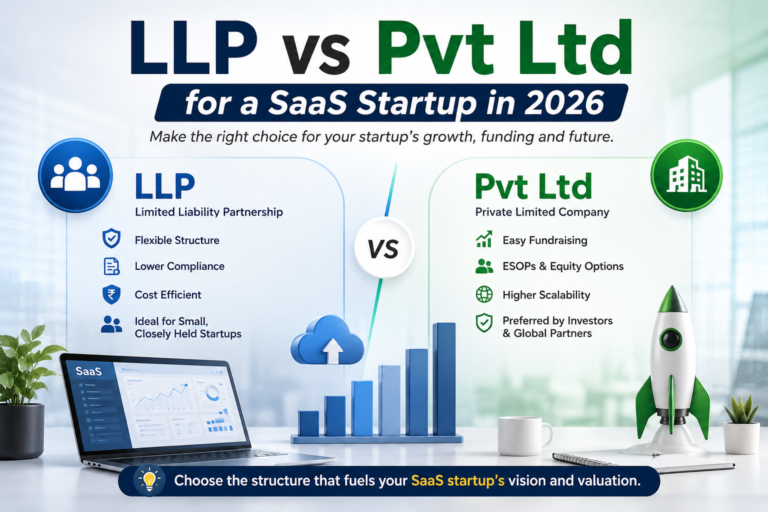
- Limited Liability Partnership (LLP) – Suitable for two or more partners who want limited liability with lighter compliance than a company. A good fit for mid-sized restaurants and catering firms.
- Private Limited Company – Best if you plan to scale, open multiple outlets, franchise or raise investment. It offers limited liability, a separate legal identity and strong credibility with banks and investors.
| Feature | Proprietorship | LLP | Private Limited |
|---|---|---|---|
| Liability | Unlimited | Limited | Limited |
| Ideal for | Small single owner | Small partnerships | Scaling and funding |
| Compliance | Low | Medium | High |
| Fundraising | Difficult | Moderate | Easy |
Step 2: FSSAI Registration and Licensing
Every food business operator (FBO) in India must be registered with the Food Safety and Standards Authority of India (FSSAI). The type of FSSAI approval you need depends mainly on your annual turnover and scale of operations.
| Category | Who it is for | Annual turnover |
|---|---|---|
| Basic Registration | Petty FBOs, small vendors, home and cloud kitchens, hawkers | Up to Rs 12 lakh |
| State License | Small to medium manufacturers, restaurants and traders | Rs 12 lakh to Rs 20 crore |
| Central License | Large units, importers/exporters, e-commerce and multi-state operators | Above Rs 20 crore |
FSSAI licences are issued for one to five years and must be renewed before expiry. The 14-digit FSSAI number has to be displayed at your premises and printed on your packaging.
Step 3: GST Registration and Food GST Rates
GST registration becomes mandatory once your turnover crosses the threshold – Rs 40 lakh for suppliers of goods (Rs 20 lakh in special category states) and Rs 20 lakh for service providers such as restaurants (Rs 10 lakh in some states). Registration is also compulsory if you sell through e-commerce platforms like Swiggy or Zomato, or supply across state borders.
Indicative GST rates for the food sector in 2026:
- Standalone restaurants (AC and non-AC): 5% without input tax credit.
- Restaurants in hotels with room tariff above Rs 7,500 per night: 18% with input tax credit.
- Food supplied through e-commerce operators: 5%, with the platform liable to pay under the notified provisions.
- Packaged and processed foods: 5%, 12% or 18% depending on the specific product.
- Fresh, unbranded and unpackaged staples: generally nil-rated or exempt.
Step 4: Trade Licence and Local Approvals
A trade licence from your local municipal corporation or panchayat authorises you to run a food establishment at a specific location. Depending on your model and city, you may also need:
- Shop and Establishment registration under the state labour department
- Eating House Licence from the local police for dine-in outlets
- Fire safety NOC for larger premises
- Health or sanitary licence from the municipal health department
- Liquor licence, if you intend to serve alcohol
- Signage and Pollution Control Board (Consent to Operate) clearances where applicable
Step 5: Other Registrations to Consider
- PAN and TAN for the business entity
- A current bank account in the business name
- Udyam (MSME) registration for subsidies and easier credit
- Professional tax registration in applicable states
- EPF and ESIC registration once you cross the employee thresholds
- Trademark registration to protect your brand name and logo
Documents Required
- PAN and Aadhaar of the proprietor, partners or directors
- Passport-size photographs
- Proof of premises (rent agreement or ownership deed and a utility bill)
- No-objection certificate from the property owner
- Entity documents (partnership deed, LLP agreement or certificate of incorporation)
- List of food products and a basic food safety management plan
- Bank account details and a cancelled cheque
- Premises layout plan for State and Central FSSAI applications
Step-by-Step Process
- Decide your model (restaurant, cloud kitchen, packaged food, catering or food truck) and choose a suitable structure.
- Register the business entity and obtain PAN and TAN.
- Open a current bank account in the business name.
- Apply for the appropriate FSSAI registration or licence based on turnover and scale.
- Register for GST if you cross the threshold or sell online.
- Obtain the trade licence and other local clearances such as health, fire and eating house approvals.
- Complete additional registrations like Udyam, professional tax, EPF and ESIC as applicable.
- Set up compliant packaging, labelling and record-keeping, then begin operations.
Timeline and Estimated Effort
| Task | Typical timeline |
|---|---|
| Proprietorship setup | 1 to 3 days |
| LLP or Private Limited incorporation | 7 to 15 days |
| FSSAI Basic Registration | 7 to 10 days |
| FSSAI State License | 15 to 30 days |
| FSSAI Central License | 30 to 60 days |
| GST registration | 3 to 7 working days |
| Trade licence | 7 to 21 days |
Start Your Food Business the Right Way
Getting the structure, licences and tax registrations right from day one saves you penalties, delays and stress later. If you would rather focus on your food while experts handle the paperwork, you can launch your business with TAXAJ and get end-to-end support with incorporation, FSSAI, GST and ongoing compliance.
Frequently Asked Questions
Is FSSAI registration mandatory for a home-based food business?
Yes. Even home kitchens, cloud kitchens and tiffin services must obtain at least an FSSAI Basic Registration before they start selling food.
Which business structure is best for a single-owner food startup?
A sole proprietorship is the quickest and cheapest to start. If you plan to scale or raise funding, a Private Limited Company or LLP offers limited liability and better credibility.
Do cloud kitchens need a trade licence?
Yes. Cloud kitchens operate from a physical premises and generally require a trade licence, FSSAI licence, GST registration and health and fire clearances depending on the location.
What GST rate applies to restaurants in 2026?
Most standalone restaurants charge 5% GST without input tax credit. Restaurants located in hotels with room tariffs above Rs 7,500 per night charge 18% with input tax credit.
How long does it take to start a food business in India?
A small proprietorship with Basic FSSAI and GST can be operational within 2 to 3 weeks. Larger setups needing State or Central FSSAI licences and multiple clearances may take 6 to 8 weeks.

Abhilesh Jha is a Chartered Accountant and the Founder & CEO of TAXAJ. With over 12 years of experience across taxation, audit, corporate law and business advisory, Abhilesh leads TAXAJ's mission to make finance, tax and compliance simple for businesses. TAXAJ is a multi-disciplinary consulting firm spanning finance, taxation, legal, secretarial, FEMA and IPR, with offices in Delhi, Bihar, Bangalore and Goa.
View all posts by Abhilesh Jha →