Converting a Private Limited Company to a Sole Proprietorship in India (2026)
A common question TAXAJ receives is whether a private limited company can be "converted" into a sole proprietorship. The honest answer is: there is no direct legal conversion route under Indian law. A private limited company and a proprietorship are fundamentally different legal structures — the company is a separate legal person registered with the Ministry of Corporate Affairs (MCA), while a proprietorship is simply an individual doing business in their own name. To move from one to the other, you must close (strike off) the company and separately set up a new proprietorship. This guide explains why owners choose this path in 2026, the exact steps to wind up the company, tax and asset-transfer points, and how to start the proprietorship.
Why owners want to go from Pvt Ltd to proprietorship
A private limited company offers limited liability and a professional image, but it also carries a heavy fixed cost of compliance regardless of turnover. Owners of small or dormant companies often find the burden disproportionate to the scale of their business.
- Annual compliance load: Mandatory filings such as AOC-4 (financials), MGT-7/MGT-7A (annual return), board meetings, statutory audit, and director DIR-3 KYC apply even to a company with little or no activity.
- Recurring cost: Auditor fees, professional retainers, and ROC filing fees add up every year. A proprietorship has none of these MCA obligations.
- Penalties for non-compliance: Late MCA filings attract a penalty of Rs 100 per form per day with no upper cap, which mounts quickly on a neglected company.
- Simplicity: A proprietor files only a personal income tax return and, where applicable, GST returns — a far lighter footprint.
The trade-off is significant: a proprietorship gives up limited liability. The owner becomes personally responsible for all business debts. Read the alternatives section below before deciding.
Step 1: Clear liabilities and get internal approval
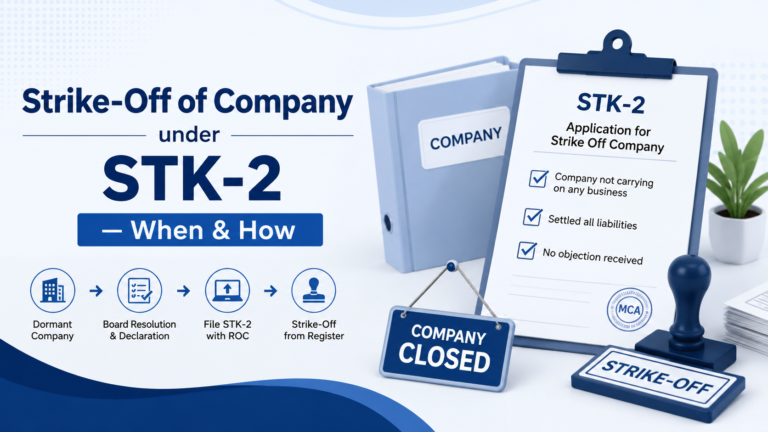
The practical closure route for most inactive companies is a voluntary strike off under Section 248(2) of the Companies Act, 2013, using form STK-2. This is available where the company has either not commenced business, or has not been carrying on any business for the two immediately preceding financial years and has not applied for dormant status.
Before you can file, the company must be genuinely "clean":
- Settle or discharge all outstanding liabilities, loans, and creditors.
- Vacate or satisfy any charges registered with the ROC.
- Bring all overdue annual filings up to date (AOC-4, MGT-7/MGT-7A) and complete DIR-3 KYC for every director.
- Close the company's bank accounts and obtain a nil-balance closure certificate.
Next, secure internal approval. The board passes a resolution authorising the strike off, followed by a special resolution of shareholders (75% approval), or written consent from members holding at least 75% of paid-up share capital.
Step 2: Settle statutory dues (GST and income tax)
Statutory registrations must be wound down cleanly, or the strike off will be objected to:
- GST: Apply to cancel the GST registration and file the final return in GSTR-10 within the prescribed period.
- Income tax: File the company's final income tax return and ensure there are no pending demands or refunds outstanding.
- Other licences: Surrender professional tax, Shops & Establishment, import-export code, or industry licences no longer needed.
Step 3: File STK-2 with the ROC
Once the company is clean and approvals are in place, the application is filed with the Registrar of Companies. The key attachments to STK-2 are:
| Document / Form | Purpose |
|---|---|
| STK-2 (application) | Main strike-off application to the ROC |
| STK-3 (indemnity bond) | Directors indemnify against future claims |
| STK-4 (affidavit) | Sworn declaration by each director |
| STK-8 (statement of accounts) | Statement of assets and liabilities, not older than 30 days, certified by a CA |
| Special resolution / consent | Shareholder approval for closure |
The government filing fee for STK-2 is a flat Rs 5,000. After filing, the ROC publishes a public notice inviting objections for 30 days; if none are sustained, it issues the strike-off order and the company's name is removed from the register. The whole process typically takes about 3 to 6 months. Note that struck-off companies can be restored by the NCLT within a limited window, so the closure must be genuine.
Tax and asset-transfer considerations
This is where many owners underestimate the complexity. Because the company is a separate legal person, its assets do not automatically pass to you as an individual — they must be transferred, and that transfer can trigger tax.
- Distribute before strike off: A company cannot be struck off while it still holds assets. Assets must be sold, settled, or distributed to shareholders first.
- Capital gains and deemed dividend: Transferring assets to shareholders or distributing accumulated reserves can attract capital gains tax and be taxed as a dividend in the shareholder's hands. Plan this with a professional.
- Buying assets into the proprietorship: If your new proprietorship acquires the company's equipment, stock, or goodwill, it should do so at fair value with proper documentation and applicable GST.
- No tax-neutral rollover: Unlike a company-to-company reorganisation, there is no slump-sale or amalgamation relief for a company winding down into an individual proprietorship.
Step 4: Set up the sole proprietorship
A proprietorship is quick and inexpensive to start because it is not a registered entity in itself — it is you. There is no MCA registration. Instead, you obtain the operational registrations your business needs:
- Udyam (MSME) registration: Free online registration that gives your firm an official identity and eligibility for MSME benefits.
- GST registration: Required if turnover crosses the threshold or you trade inter-state or online.
- Current bank account: Opened in the firm's name, usually using Udyam plus GST (or two business-identity proofs) along with your PAN and Aadhaar.
- Local licences: Shops & Establishment registration and any trade-specific licence.
Your business income is now reported under your personal PAN and taxed at individual slab rates, with the presumptive scheme (Section 44AD/44ADA) available to many small proprietors.
A better alternative for solo owners: OPC
If your main goal is to cut compliance while keeping limited liability, closing the company entirely may be the wrong move. A One Person Company (OPC) lets a single individual run a corporate entity with liability protection and lighter compliance than a regular private limited company. In many cases converting your Pvt Ltd into an OPC, rather than dissolving it, preserves your assets, brand, and legal continuity. If you are unsure which route fits you, our team can compare the numbers with you — explore our guidance on the One Person Company structure before you decide to shut the company down.
Frequently asked questions
Can I directly convert my private limited company into a proprietorship?
No. Indian law has no direct conversion mechanism between these two structures. You must strike off (close) the company and separately register a new proprietorship in your own name.
How much does it cost and how long does it take to close the company?
The STK-2 government fee is Rs 5,000, plus professional fees for preparing documents and clearing filings. The ROC process generally takes 3 to 6 months, longer if there are pending compliances to fix first.
What happens to the company's assets and bank balance?
They must be settled before strike off — a company cannot be struck off while holding assets or liabilities. Assets are sold or distributed to shareholders, which may attract capital gains or dividend tax, so plan the transfer carefully.
Does a sole proprietorship need any registration?
There is no central registration for a proprietorship itself. In practice you obtain Udyam (MSME) registration, GST (if applicable), a current account, and any local Shops & Establishment or trade licence.
Is it worth keeping limited liability instead of closing?
Often, yes. If liability protection matters, converting to an OPC or retaining the company usually beats becoming a proprietor. A proprietorship exposes your personal assets to all business debts.