
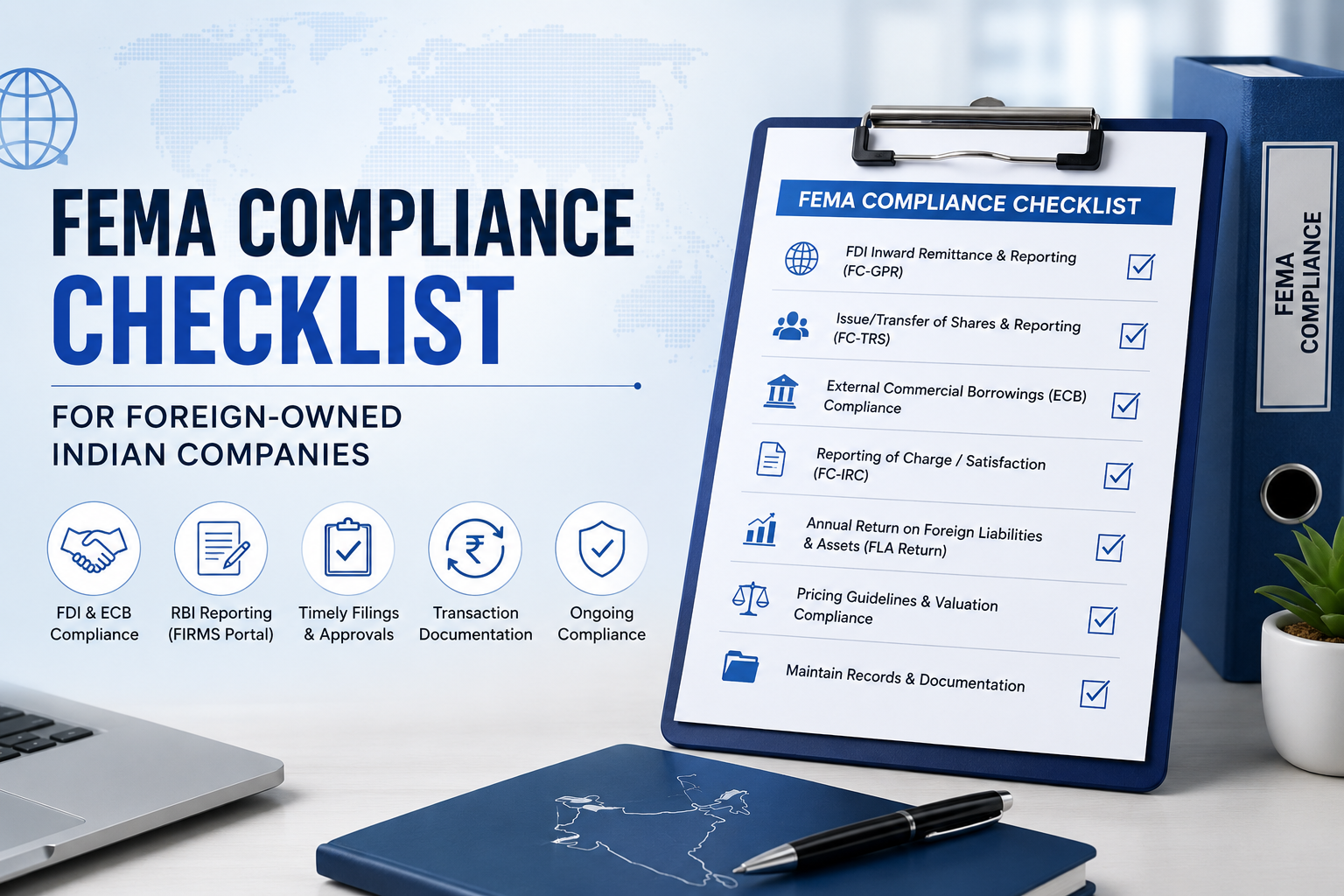
FEMA compliance checklist for foreign-owned Indian companies
Introduction
India continues to be one of the world’s most attractive investment destinations, welcoming foreign investment across various sectors through the Foreign Direct Investment (FDI) route. However, once a foreign investor acquires ownership in an Indian company, compliance under the Foreign Exchange Management Act, 1999 (FEMA) becomes a continuous responsibility.
Failure to comply with FEMA regulations can result in penalties, delayed approvals, compounding proceedings, and regulatory scrutiny. Therefore, every foreign-owned Indian company should maintain a structured compliance framework to ensure timely reporting and adherence to Reserve Bank of India (RBI) regulations.
This checklist highlights the key FEMA compliances that every foreign-owned Indian company should monitor.
1. Verify the FDI Entry Route
Before accepting foreign investment, confirm:
- Whether the sector permits 100% FDI.
- Whether investment falls under the Automatic Route or requires Government Approval.
- Applicable sectoral caps and conditions.
- Any prohibited sectors or investment restrictions.
Entering under the wrong route can lead to regulatory complications and delays.
2. Ensure Compliance with Pricing Guidelines
Foreign investments and share transfers must comply with RBI pricing norms.
The company should ensure:
- Shares are issued or transferred at the prescribed valuation.
- Valuation certificates are obtained from eligible professionals wherever required.
- Pricing complies with FEMA regulations and applicable RBI directions.
3. Timely Reporting of Share Allotment (FC-GPR)
When shares are issued to a foreign investor:
✔ Complete allotment within the prescribed timeline under the Companies Act.
✔ File Form FC-GPR through the RBI FIRMS Portal within the prescribed FEMA timeline after allotment.
Supporting documents generally include:
- Board Resolution
- Valuation Certificate
- FIRC/Foreign Inward Remittance evidence
- KYC Report from the Authorized Dealer Bank
- Company Secretary’s Certificate (where applicable)
4. Report Transfer of Shares (FC-TRS)
Whenever shares are transferred between:
- Resident to Non-Resident
- Non-Resident to Resident
the transaction should be reported through Form FC-TRS within the prescribed timeline along with supporting documentation.
5. File the Annual FLA Return
Companies that have received foreign investment or made overseas investment are generally required to submit the Foreign Liabilities and Assets (FLA) Return annually to the RBI.
The return captures:
- Foreign equity
- Outstanding liabilities
- Overseas assets
- Financial position of the company
Accurate financial data is essential before filing.
6. Maintain FEMA Documentation
Maintain proper records of:
- Share certificates
- Share allotment documents
- Board and shareholder resolutions
- Valuation reports
- KYC reports
- Bank advice and remittance records
- RBI acknowledgements and filing confirmations
Well-maintained documentation simplifies audits and future transactions.
7. Monitor Downstream Investment Compliance
If the Indian company invests in another Indian entity while having foreign investment, evaluate whether the transaction qualifies as Downstream Investment.
Where applicable:
- Ensure compliance with FEMA conditions.
- Complete necessary reporting.
- Verify sectoral eligibility of the investee company.
8. Coordinate FEMA and Companies Act Compliances
FEMA reporting should always be aligned with corporate compliances such as:
- PAS-3 (Return of Allotment)
- Board and Shareholder approvals
- Updating statutory registers
- Share certificate issuance
- Beneficial ownership records, wherever applicable
Proper coordination avoids inconsistencies between MCA and RBI records.
9. Conduct Periodic FEMA Compliance Reviews
Instead of waiting for annual audits, companies should periodically review:
- Pending FEMA filings
- Reporting timelines
- Shareholding changes
- Foreign remittances
- Capital structure changes
Regular compliance reviews help identify issues before they become regulatory concerns.
10. Work with Experienced Compliance Professionals
FEMA regulations are frequently updated through RBI directions and government notifications. Professional guidance helps companies:
- Avoid reporting delays
- Interpret regulatory changes
- Structure transactions correctly
- Prepare accurate documentation
- Respond efficiently during audits or due diligence
Common FEMA Compliance Mistakes
Many foreign-owned companies inadvertently make mistakes such as:
- Delayed FC-GPR or FC-TRS filings
- Incorrect valuation methodology
- Missing KYC documentation
- Non-filing of FLA Return
- Failure to identify downstream investments
- Poor maintenance of FEMA records
A compliance calendar and periodic review process can significantly reduce these risks.
Conclusion
FEMA compliance is not a one-time obligation following foreign investment—it is an ongoing regulatory responsibility. Foreign-owned Indian companies should establish a proactive compliance framework covering FDI reporting, annual filings, documentation, valuation, and monitoring of future transactions.
A disciplined approach to FEMA compliance not only minimizes regulatory risk but also strengthens investor confidence, facilitates future fundraising, and ensures smooth business operations.
📲 Stay Connected & Learn More
👉 Join our WhatsApp Channel for daily updates on FEMA, RBI, GST, ROC, and Tax Compliance:
🔗 https://whatsapp.com/channel/0029VaAOrtiFCCoQlhtGIx2o
👉 Explore more informational content on our YouTube Channel:
🔗 https://www.youtube.com/@taxajca
📞 Need assistance with FEMA or RBI compliances?
Reach out via Call or WhatsApp: +91 8802912345
Need help with this? TAXAJ can do it for you.
Get expert help →
Pooja Sarvang is a Company Secretary in TAXAJ's Accounts & Taxation team. With over six years of experience in corporate secretarial, governance and compliance matters, Pooja helps companies meet their statutory obligations under the Companies Act and allied laws. TAXAJ is a multi-disciplinary consulting firm spanning finance, taxation, legal, secretarial, FEMA and IPR, with offices in Delhi, Bihar, Bangalore and Goa.
View all posts by Pooja Sarvang →