
Ship-To GSTIN field and E-Way Bill closure feature live 15 June 2026
Two changes to the GST e-way bill and e-invoice systems matter for anyone who ships goods to an address other than the buyer’s: the Ship-To GSTIN field and the e-way bill closure functionality. Both are aimed at the same problem — the system previously struggled to tell who was billed and who actually received the goods, which produced reconciliation mismatches that surfaced months later during scrutiny. If your business handles third-party deliveries, job work, branch transfers or e-commerce fulfilment, this affects your billing software and your documentation process, not just your GST return.
What has changed
The updated functionality gives businesses a way to report transactions where the recipient of the invoice and the party physically receiving the goods are different. The Ship-To GSTIN field identifies the GST-registered entity to whom goods are actually shipped, while the closure functionality provides a mechanism to appropriately close or update an e-way bill in defined circumstances. Neither changes what tax you pay — they change how accurately the movement is described in the system, which is what reconciliation runs on.
What the Ship-To GSTIN captures
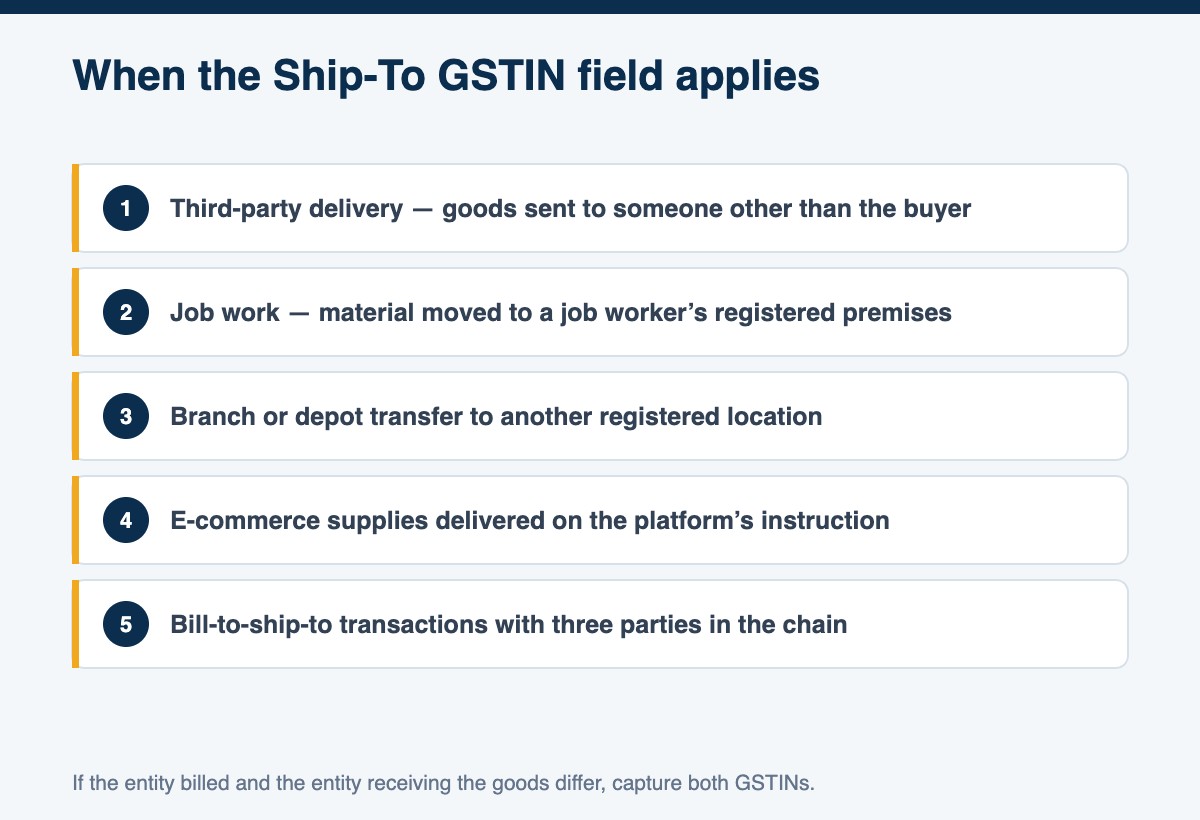
In a straightforward sale, the entity billed and the entity receiving the goods are the same, and billing and shipping details are identical. Modern supply chains routinely break that assumption: a buyer instructs delivery to a different registered location, or a third party takes physical receipt. The Ship-To GSTIN records the GSTIN of the registered entity actually receiving the consignment, wherever applicable, so the paper trail matches the physical movement.
Bill-To versus Ship-To
The distinction is worth making explicit for accounts and logistics teams, because they tend to hold different halves of it:
- Bill-To identifies the customer being invoiced. It drives the tax invoice, the buyer’s GSTIN, the billing address and your GST reporting.
- Ship-To identifies the recipient and location of the shipment. It drives the delivery address, the Ship-To GSTIN where applicable, and the e-way bill.
Take a worked example. Company A buys machinery from Company B but instructs delivery straight to Company C’s registered premises. Company B invoices A, so A is Bill-To; the goods move to C, so C is Ship-To. Report only A and the documentation no longer describes the actual movement of goods.
Why place of supply still governs the tax
Recording a Ship-To GSTIN does not by itself determine the tax treatment. The place of supply provisions decide whether a transaction is intra-state or inter-state, and therefore whether CGST and SGST or IGST applies. In a bill-to-ship-to chain the place of supply is generally determined with reference to the party on whose direction the goods move, which is why the two legs of the transaction can carry different treatment. Confirm the head and the split on the TAXAJ GST calculator once you have fixed the place of supply, rather than assuming it follows the delivery address.
The e-way bill closure functionality
E-way bills are generated for a movement of goods and carry a validity linked to distance. Real consignments do not always complete as planned — a delivery is aborted, goods are returned in transit, a vehicle changes, or a bill is generated in error. The closure functionality gives a route to close or update the e-way bill in these situations, so that open bills do not sit unresolved against your GSTIN. Treat an open or stale e-way bill the way you would treat an unreconciled ledger item: something to clear in the current cycle, not later.
What to change in your systems
The practical work is mostly upstream of the GST portal:
- Add Ship-To fields to your masters. Your ERP or billing software must store a Ship-To GSTIN and address separately from the billing GSTIN, not overwrite one with the other.
- Fix the data capture point. Sales staff taking the order are the ones who know the goods are going elsewhere — the field has to be filled at order entry, not reconstructed by accounts at month end.
- Brief your logistics partners so that the consignment documentation matches what was reported.
- Add an e-way bill exception review to your monthly close, covering bills that expired, were cancelled, or relate to aborted movements.
- Reconcile against your returns. Movements reported here should tie back to the outward supplies in your GSTR-1; see our guide to GSTR-1 and GSTR-3B filing timelines.
Where businesses get this wrong
The recurring failures are relying on the customer’s billing GSTIN for every field because it is the one already in the master, leaving the Ship-To blank in job work movements on the view that the goods are coming back anyway, and treating an e-way bill as complete once the vehicle departs. Each of these produces a mismatch between what the system shows and what happened — and mismatches on goods movement are among the easier things for the department to query, because the data is structured and comparable.
The knock-on effect on input tax credit
Your customer’s credit depends on the supply being reported correctly and appearing in their statement. Documentation that misdescribes a bill-to-ship-to chain creates a credit problem for the recipient, which becomes a commercial problem for you. The conditions the recipient has to satisfy are set out in our guide to input tax credit under GST. If you need help configuring invoicing and e-way bill processes end to end, TAXAJ’s GST return and compliance team can review your current setup.
Frequently asked questions
Is the Ship-To GSTIN mandatory for every invoice?
No. It is relevant where the entity receiving the goods differs from the entity being billed. In a simple sale where the buyer takes delivery at its own registered premises, the billing details already describe the movement.
Does a Ship-To GSTIN change whether I charge CGST/SGST or IGST?
Not directly. The tax head follows the place of supply, determined under the relevant IGST provisions. In bill-to-ship-to chains the two legs are assessed separately, so it is possible for one leg to be inter-state and the other intra-state.
What should I do about an e-way bill for a delivery that never completed?
Use the available cancellation or closure route within the permitted window rather than leaving it open. Record the reason internally, because an unexplained gap between a reported movement and your sales records is exactly what a later reconciliation will flag.
Do these changes affect job work movements?
Yes, in the sense that job work is a common case where goods move to a registered party other than the buyer, so the Ship-To details are the ones that describe the movement accurately. The underlying job work procedure and documentation requirements are unchanged.

Mayank Saini is a Manager at TAXAJ's Goa office, part of the Accounts & Taxation team. With over six years of industry experience, Mayank advises businesses on accounting, taxation and regulatory compliance. TAXAJ is a multi-disciplinary consulting firm spanning finance, taxation, legal, secretarial, FEMA and IPR, with offices in Delhi, Bihar, Bangalore and Goa.
View all posts by Mayank Saini →