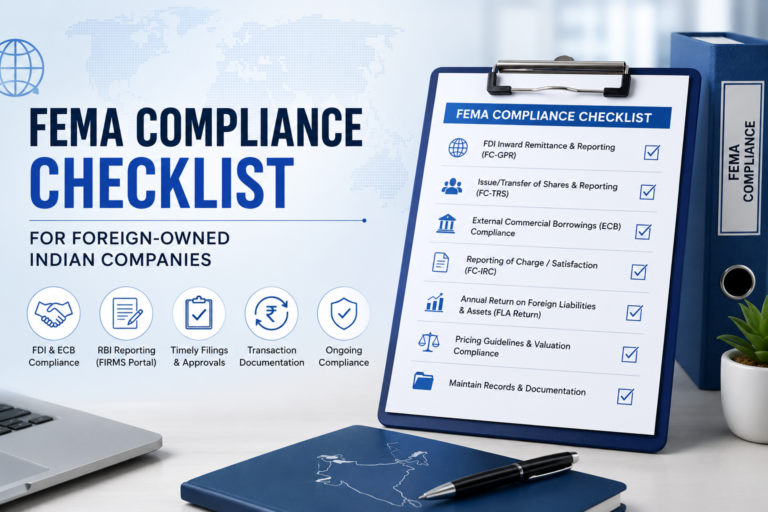
FEMA Guarantees Regulations 2026 — Cross-Border Guarantee Compliance
Introduction
The Reserve Bank of India (RBI) has introduced the Foreign Exchange Management (Guarantees) Regulations, 2026, replacing the earlier FEMA (Guarantees) Regulations, 2000. The new framework, notified through Notification No. FEMA 8(R)/2026-RB dated 6 January 2026, represents a significant change in the regulatory treatment of guarantees involving Indian residents and non-residents. The regulations came into effect from the date of their publication in the Official Gazette.
The new framework adopts a more principle-based and transaction-aligned approach, while introducing a comprehensive quarterly reporting mechanism. This is particularly relevant for Indian companies, LLPs, promoters, overseas subsidiaries, foreign parent companies, lenders and other parties involved in cross-border financing or commercial arrangements.
What Is a Cross-Border Guarantee?
A cross-border guarantee is broadly a guarantee arrangement in which at least one party is a person resident in India and another party is a person resident outside India.
The regulations examine the role played by each party, including:
Principal Debtor – the person whose obligation is guaranteed.
Surety – the person providing the guarantee.
Creditor – the person in whose favour the guarantee is provided.
The 2026 Regulations establish specific conditions depending upon the capacity in which the Indian resident participates in the guarantee arrangement.
Key Change Under the 2026 Regulations
The earlier 2000 framework was largely based on specified categories of permitted guarantees. The 2026 framework moves towards a broader principle-based approach.
In general, an Indian resident may act as a surety or principal debtor in a cross-border guarantee where the underlying transaction is permitted under FEMA and the applicable borrowing/lending eligibility conditions are satisfied.
However, this does not mean that every cross-border guarantee is automatically permitted. Businesses must examine the underlying transaction, the status of the parties, the nature of the guarantee and the applicable FEMA framework before entering into the arrangement.
Conditions for Providing a Cross-Border Guarantee
Where an Indian resident acts as a surety or principal debtor, important conditions include:
The underlying transaction should not be prohibited under FEMA.
The relevant parties should satisfy the applicable eligibility requirements under the foreign exchange borrowing and lending framework.
The guarantee should be connected with a permissible underlying transaction.
The transaction should be properly documented and reported through the prescribed mechanism.
Certain specific situations are carved out from the general eligibility conditions, including certain guarantees issued by Authorised Dealer banks backed by counter-guarantees or 100% collateral from non-residents, guarantees issued by Indian agents of foreign shipping or airline companies to Indian authorities, and arrangements where both the surety and principal debtor are residents.
Can an Indian Resident Receive a Guarantee From a Non-Resident?
One notable feature of the 2026 framework is that a resident creditor may arrange or receive a guarantee in its favour, subject to the conditions prescribed under FEMA.
Where both the principal debtor and surety are non-residents, the underlying transaction must still be permissible under FEMA. This provides greater flexibility for certain cross-border commercial and financing structures while retaining regulatory safeguards.
Important Exemptions
Certain transactions are outside the scope of the Guarantees Regulations, 2026. These include:
Guarantees issued by overseas branches of Authorised Dealer banks or branches located in an IFSC, unless another party to the guarantee is a person resident in India.
Certain irrevocable payment commitments issued by Authorised Dealer banks acting as custodian banks for registered Foreign Portfolio Investors.
Guarantees provided under the Foreign Exchange Management (Overseas Investment) Regulations, 2022.
Businesses should therefore first determine whether a proposed guarantee falls within the regulations or one of the specified exclusions.
New Quarterly Reporting Requirement
One of the most important changes is the introduction of mandatory quarterly reporting for covered guarantees.
The reporting requirement covers:
Issuance of a guarantee;
Modification of guarantee terms;
Change in guarantee amount;
Extension of the guarantee period;
Pre-closure of the guarantee; and
Invocation of the guarantee.
The prescribed reporting forms include Form GRN Issue, Form GRN Modification and Form GRN Invocation.
Reporting Timeline
The person responsible for reporting must submit the relevant information to the designated Authorised Dealer (AD) bank within 15 calendar days from the end of the relevant quarter.
The AD bank is required to submit the return to the RBI within 30 calendar days from the end of the respective quarter.
This makes timely maintenance of guarantee records particularly important for companies having multiple cross-border guarantees.
Who Is Responsible for Reporting?
The regulations allocate reporting responsibility depending upon the structure of the guarantee.
Broadly:
Where the surety is resident in India, the surety is responsible for reporting.
Where the surety is a non-resident and the principal debtor, who arranged the guarantee, is resident in India, the principal debtor is responsible.
In certain cases involving a non-resident surety and non-resident principal debtor, the creditor may have the reporting responsibility, particularly where the creditor arranged the guarantee.
Companies should therefore identify the reporting party at the time the guarantee is structured rather than waiting until the reporting deadline.
Late Submission Fee
The 2026 Regulations introduce a specific Late Submission Fee (LSF) mechanism for delayed reporting.
The LSF is calculated broadly as:
₹7,500 + 0.025% × Amount Involved × Period of Delay
The period of delay is calculated in years, rounded upwards to the nearest month and expressed up to two decimal places. The resulting fee is rounded upwards to the nearest hundred rupees.
This provides a structured mechanism for regularising delayed reporting and makes timely FEMA compliance even more important.
Practical Impact on Indian Companies and LLPs
The new regulations are particularly relevant for entities that:
Provide corporate guarantees for overseas group entities;
Receive guarantees from foreign parent companies;
Obtain overseas financing backed by guarantees;
Provide guarantees in connection with cross-border commercial transactions;
Have foreign subsidiaries or group companies;
Have promoters providing personal guarantees in cross-border financing arrangements; or
Participate in transactions involving overseas lenders or creditors.
The framework can affect both corporate and personal guarantee arrangements, depending on the parties and underlying transaction.
FEMA Compliance Checklist for Cross-Border Guarantees
Before issuing or accepting a cross-border guarantee, businesses should consider the following checklist:
Identify all parties and determine their FEMA residential status.
Identify the role of each party — principal debtor, surety and creditor.
Examine the underlying transaction and confirm that it is permissible under FEMA.
Check borrowing/lending eligibility, wherever applicable.
Review the guarantee documentation and commercial terms.
Determine whether an exemption applies.
Identify the designated AD bank.
Determine the reporting responsibility.
File the applicable Form GRN within the prescribed timeline.
Report subsequent modifications, extensions, pre-closure or invocation.
Maintain supporting documents and evidence of submission.
Monitor delayed filings and LSF exposure.
Difference Between the 2000 and 2026 Framework
Particulars 2000 Regulations 2026 Regulations
Regulatory approach More transaction/category based Principle-based
Cross-border guarantee framework Specified permitted transactions Broader permission subject to prescribed conditions
Role-based approach Less structured Principal debtor, surety and creditor clearly identified
Quarterly reporting No comparable comprehensive framework Mandatory quarterly reporting
Reporting form Earlier reporting mechanisms varied Form GRN framework
Modification reporting Not covered through a uniform framework Specifically reportable
Invocation reporting Existing sector-specific requirements Specifically covered
Late Submission Fee No comparable structured LSF under the guarantee regulations Specific LSF mechanism introduced
The 2026 framework therefore represents a significant shift towards standardised reporting, transaction-level assessment and greater regulatory transparency.
Conclusion
The FEMA (Guarantees) Regulations, 2026 are an important development for businesses undertaking cross-border financing and commercial transactions. While the new framework provides greater flexibility through a principle-based approach, it simultaneously places greater emphasis on reporting, documentation and ongoing compliance.
For Indian companies and LLPs, a cross-border guarantee should not be treated merely as a contractual or banking document. Its FEMA implications should be evaluated before execution, and the applicable reporting obligations should be tracked throughout the life of the guarantee.
The introduction of Form GRN, quarterly reporting and a structured Late Submission Fee means that businesses should establish an internal FEMA guarantee register and compliance calendar to avoid delayed reporting and unnecessary regulatory exposure.

Aradhana Singh is a CA Intern in TAXAJ's Accounts & Taxation team, currently pursuing the Chartered Accountancy qualification. Aradhana supports clients on taxation, audit and compliance assignments. TAXAJ is a multi-disciplinary consulting firm spanning finance, taxation, legal, secretarial, FEMA and IPR, with offices in Delhi, Bihar, Bangalore and Goa.
View all posts by Aradhana Singh →