Best GST Billing Software for Indian Retailers 2026 — Features and Price Compared
🧾 Why GST billing software matters for retailers in 2026
For an Indian retailer, billing software is no longer just a tool for printing invoices. A good system should connect sales, GST invoicing, inventory, customer balances, purchases and business reports without forcing the owner to maintain everything separately.
This becomes particularly important as a retail business grows. A shop may begin with a few hundred products and one billing counter, but eventually need barcode scanning, multiple users, stock control, purchase management, e-invoicing, e-way bills and accounting integration.
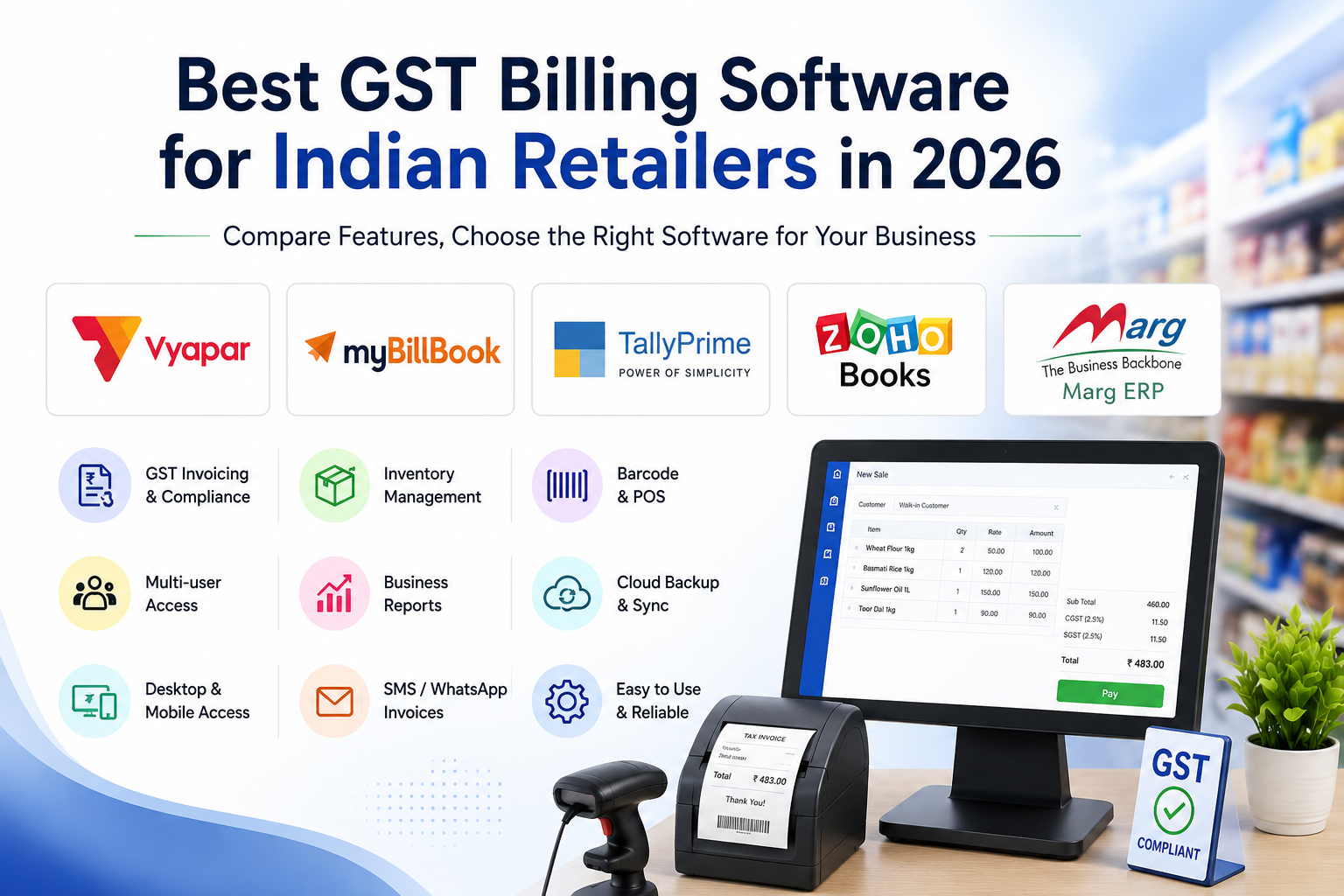
In 2026, several software options compete for this market, including Vyapar, myBillBook, TallyPrime, Zoho Books and Marg ERP. They are not identical products, however. Some are designed primarily for easy retail billing, while others are full accounting or ERP platforms.
Key takeaway: The cheapest GST billing software is not necessarily the best choice. Retailers should choose based on billing speed, inventory complexity, accounting requirements, number of users and whether the business is expected to grow.
🏪 What should retailers look for in GST billing software?
A retailer should first check whether the software can generate GST-compliant invoices with the correct GSTIN, HSN/SAC information, tax rates and CGST, SGST or IGST treatment.
The next major requirement is inventory. A useful retail system should update stock when purchases and sales are recorded and should provide visibility over low-stock items, product-wise sales and closing inventory.
Barcode support can make a significant difference for shops with hundreds or thousands of SKUs. Retailers should also consider whether the software works with thermal printers, barcode scanners, weighing scales and POS hardware where required.
For businesses selling on credit, customer ledger and payment-reminder functionality can be just as important as billing itself.
Finally, the retailer should consider whether the software supports GST reports, e-invoicing and e-way bills where applicable. These features can reduce manual work, but the software does not eliminate the taxpayer’s responsibility to ensure that the underlying transaction data is correct.
📱 Vyapar — best for simple retail billing and small businesses
Vyapar official website
Vyapar is one of the most popular choices for small Indian retailers because it combines billing, inventory and basic accounting in a relatively simple interface.
Its feature set includes GST billing, inventory management, payment tracking and business reports. Vyapar also supports functions such as e-invoicing, e-way bills and WhatsApp invoice sharing, depending on the plan and platform selected.
Current 2026 pricing information shows Vyapar plans starting around ₹3,399 per year for desktop access, while desktop-plus-mobile plans are priced higher. A current published plan sheet shows one-year desktop plans from ₹3,399 plus GST and desktop-plus-mobile plans from ₹3,999 plus GST, with higher-tier plans available for more advanced requirements.
For a small retailer who primarily wants fast GST billing, stock management and straightforward accounting without implementing a full ERP, Vyapar is a strong option.
The main consideration is that the exact features available depend on the plan, so retailers should not compare the entry-level price with the feature set of a higher-tier competitor.
🧮 myBillBook — strong choice for mobile-first retailers
myBillBook official website
myBillBook is particularly attractive to retailers who want a simple billing system that works across mobile and web platforms.
Its current plans include GST billing, inventory management, invoice customisation and barcode functionality. The company’s current pricing page shows the Diamond plan at ₹3,490 per year when billed annually, while the Platinum plan is ₹3,990 per year. The Platinum plan adds a desktop application, unlimited godown management, bulk invoice printing and other features.
The Enterprise plan adds features such as multiple businesses, additional users, unlimited e-way bills, e-invoicing, POS billing, recurring billing and Tally data export.
For a single-shop retailer, the Diamond or Platinum level can be sufficient depending on whether desktop billing is required.
myBillBook is therefore particularly suitable where ease of use and mobile accessibility are more important than advanced accounting depth.
💼 TallyPrime — best for retailers who need full accounting
TallyPrime official website
TallyPrime is fundamentally different from lightweight billing applications. It is a broader accounting and business-management platform that also provides GST-compliant billing.
For retailers who want proper accounting alongside inventory, purchase and sales management, receivables, payables, financial statements and GST reporting, TallyPrime can be a much more comprehensive solution.
TallyPrime Silver currently costs ₹750 for one month, ₹8,100 for 12 months and ₹22,500 for a lifetime licence, before 18% GST. Silver is designed for a single-PC setup. TallyPrime Gold, intended for multi-user access across multiple PCs, currently costs ₹2,250 for one month and ₹24,300 for 12 months, before GST.
Tally Solutions also states that TallyPrime’s licence provides access to the software’s full feature set, with optional costs for services such as TSS and cloud access.
For a retailer who has outgrown simple billing and wants the accounting records to become the backbone of the business, TallyPrime is one of the strongest choices.
☁️ Zoho Books — best for cloud accounting and growing businesses
Zoho Books official website
Zoho Books is a cloud accounting platform rather than a traditional retail-only billing application. It combines GST invoicing with accounting, banking, reconciliation, inventory, purchase orders, sales orders, payment reminders and financial reporting.
Its current India pricing starts with a free plan for eligible small businesses. The Standard plan costs ₹749 per organisation per month when billed annually, while the Professional plan costs ₹1,499 per month billed annually. Premium starts at ₹2,999, Elite at ₹4,999 and Ultimate at ₹7,999 per month when billed annually. Prices are exclusive of applicable local taxes.
Zoho Books also supports GST reports and filing, inventory management, banking and reconciliation and multi-GSTIN functionality.
For a retailer who wants cloud access, stronger accounting, multiple locations and integration with a wider business software ecosystem, Zoho Books is particularly compelling.
However, a very small retailer who only needs fast counter billing may find Zoho Books more extensive than necessary.
🏬 Marg ERP — best for inventory-heavy retail businesses
Marg ERP official website
Marg ERP has a particularly strong focus on retail, distribution and inventory-intensive businesses. Its platform covers billing, inventory, accounting, GST, e-invoicing and multiple locations, with specialised solutions for industries such as pharmacy, grocery, FMCG and jewellery.
Its current published India pricing starts with Marg ERP Nano at ₹5,550 plus GST. The Basic Edition is ₹10,300, Silver is ₹13,900 and Gold is ₹26,000, with the higher plans providing progressively greater user and company capabilities.
Marg is particularly useful when inventory management is complicated. A retailer with multiple godowns, large product catalogues, multiple branches or industry-specific stock requirements may find Marg more appropriate than a simple billing app.
The trade-off is that Marg can require more setup and learning than mobile-first billing applications.
💡 Which software offers the best value in 2026?
For a retailer looking primarily for affordable GST billing and basic inventory management, Vyapar and myBillBook are among the most practical choices.
myBillBook’s current Diamond plan is ₹3,490 annually and Platinum is ₹3,990 annually, while published Vyapar pricing starts around ₹3,399 annually for desktop access.
For a business where accounting is equally important as billing, TallyPrime becomes more attractive.
For a cloud-first business that wants accounting, banking, reconciliation and broader integrations, Zoho Books is the stronger fit.
For a retailer with complex inventory, multiple locations or industry-specific requirements, Marg ERP deserves serious consideration.
The important point is that these prices are not directly comparable on a simple rupee-for-rupee basis. A ₹4,000 billing application and a ₹24,000 accounting licence may serve completely different business requirements.
🧠 Don’t choose software only because it is GST compliant
Almost every serious billing platform now markets GST compliance as a core feature. That alone is not a sufficient reason to select one product over another.
The real question is whether the software helps the retailer maintain accurate transaction data.
A GST-compliant invoice generated with the wrong HSN, tax rate, customer GSTIN or place of supply can still create compliance problems. Similarly, incorrect purchase entries can affect inventory and GST reconciliation.
Retailers should therefore test the software using actual business scenarios before purchasing. Create a few sales invoices, enter purchases, issue a credit note, check stock movement, review GST reports and test the workflow for customer payments.
If the business has a CA or accountant, it is also worth checking whether the software can provide the required reports or export data in a format that makes accounting and GST reconciliation practical.
🔄 Cloud vs desktop: what should retailers choose?
The traditional desktop model still makes sense for retailers who operate primarily from one shop and want strong local accounting functionality.
Cloud-based software is more attractive when the owner wants to check sales, receivables or inventory remotely or operate multiple locations.
A mobile-first system is particularly useful for small retailers where the owner personally handles billing, purchases and collections.
There is no universal winner. The right choice depends on how the retailer actually works.
🎯 Final recommendation for Indian retailers in 2026
If the objective is simple, affordable GST billing, start by evaluating myBillBook or Vyapar.
If the retailer needs serious accounting and business reporting, TallyPrime is the stronger option.
If the priority is cloud accounting and integration, Zoho Books is worth considering.
If the business has complex inventory, multiple stores or distribution operations, Marg ERP is likely to be more suitable.
For most small retailers starting from scratch, however, the best approach is to avoid buying an unnecessarily complicated ERP. Start with software that the billing staff can use accurately and quickly, while ensuring that the underlying data can support GST compliance and proper accounting as the business grows.
Bottom line: For a typical single-store Indian retailer in 2026, myBillBook or Vyapar offers the best balance of affordability and ease of use; TallyPrime becomes the better choice when accounting depth matters, while Marg ERP is stronger for complex inventory operations and Zoho Books for cloud-first businesses.
📌 Conclusion
The best GST billing software for an Indian retailer depends on the size and complexity of the business rather than simply the lowest subscription price.
Vyapar and myBillBook are well suited to small retailers looking for easy GST billing and inventory management. TallyPrime is more appropriate when complete accounting is required. Zoho Books is attractive for cloud-based accounting and growing businesses, while Marg ERP is particularly relevant for inventory-heavy and multi-location retail operations.

Anuj Kumar is a Manager at TAXAJ's Bangalore office, working within the Accounts & Taxation team. With over six years of industry experience, Anuj advises businesses on accounting, taxation and regulatory compliance. TAXAJ is a multi-disciplinary consulting firm spanning finance, taxation, legal, secretarial, FEMA and IPR, with offices in Delhi, Bihar, Bangalore and Goa.
View all posts by Anuj Kumar →