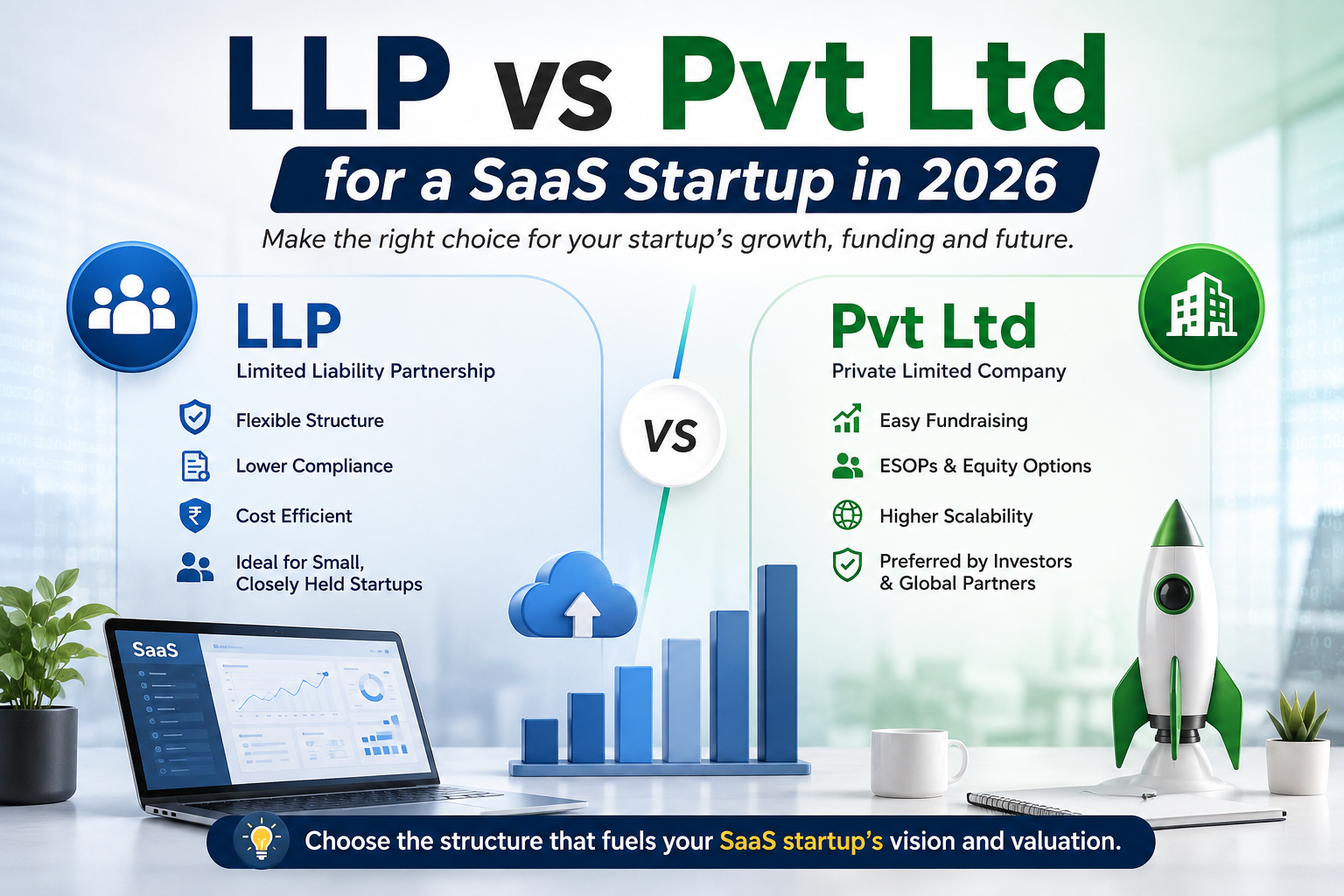
Choosing Between LLP and Pvt Ltd for a SaaS Startup in 2026
LLP or Pvt Ltd: Which structure is better for a SaaS startup?
Starting a SaaS business in India involves much more than developing a product and acquiring customers. The legal structure you choose can affect fundraising, ownership, taxation, compliance, employee incentives and even how easily the business can scale.
For many founders, the choice comes down to a Limited Liability Partnership (LLP) or a Private Limited Company (Pvt Ltd).
Both structures provide limited liability and can be used by eligible startups for DPIIT recognition. However, they are designed for somewhat different business models. For a SaaS startup that intends to raise institutional capital, issue employee stock options or eventually pursue a larger corporate transaction, a Private Limited Company will generally be the more practical structure.
An LLP can still make sense where the founders intend to remain closely held, expect limited external funding and want a relatively flexible operating structure.
What is the basic difference between an LLP and Pvt Ltd?
An LLP is a separate legal entity governed primarily by the Limited Liability Partnership Act, 2008. It combines elements of a partnership with limited liability. An LLP must have at least two designated partners, with at least one designated partner being resident in India.
A Private Limited Company, on the other hand, is incorporated under the Companies Act, 2013 and has a share-capital structure. Ownership is represented through shares, making it easier to bring in new investors and change ownership percentages through equity transactions.
This distinction becomes particularly important for SaaS businesses because SaaS is generally built around scalability. The company may begin with two founders but later involve angel investors, venture capital funds, strategic investors, employees and potentially foreign investors.
Key takeaway: The best structure is not necessarily the one with the lowest compliance cost today. For a SaaS startup, founders should also consider how the business will look after its first funding round.
Fundraising is the biggest deciding factor
For a SaaS startup planning to raise external equity capital, a Private Limited Company is usually the stronger choice.
A company has a straightforward shareholding structure. Investors can subscribe to shares or other permissible securities, and their ownership can be represented through equity percentages.
An LLP does not have a conventional share-capital structure. Investors become partners and their rights are governed through the LLP agreement and applicable law. Startup India itself notes that LLPs are less suitable where the business requires equity funding and additional shareholders.
This does not mean that an LLP cannot raise money. It means that the investment structure is materially different and may not fit the expectations of conventional venture-capital investors.
For a bootstrapped SaaS business, this distinction may not matter initially. But if the founder’s plan is to raise angel or VC funding within the next few years, incorporating as a Private Limited Company from the beginning can avoid a later restructuring exercise.
SaaS startups need to think about scalability
A SaaS business can scale rapidly without a proportionate increase in physical infrastructure. The business may start with a handful of customers and eventually serve thousands of customers across India or overseas.
As the business scales, ownership can become more complicated. New investors may enter, founders may dilute their holdings, employees may receive equity incentives and strategic investors may acquire shares.
The company structure handles these changes naturally through its shareholding framework.
An LLP can accommodate changes in partners and profit-sharing arrangements, but the structure is generally more partnership-oriented. For a SaaS startup that expects a conventional startup-capital journey, the Private Limited Company structure is usually better aligned with long-term growth.
💻 What about ESOPs for SaaS employees?
Employee incentives are another important consideration.
Technology startups often use Employee Stock Option Plans, commonly known as ESOPs, to attract and retain employees without paying the entire compensation package in cash.
A Private Limited Company can create an ESOP framework under the Companies Act, subject to the applicable legal requirements.
An LLP does not have the same conventional equity-share and ESOP framework as a company. It can potentially create contractual economic arrangements for employees or other stakeholders, but these are not equivalent to conventional company ESOPs.
Therefore, if the founders expect to build a technology team and use equity as a meaningful part of employee compensation, a Private Limited Company is generally more suitable.
What about DPIIT Startup recognition in 2026?
Choosing an LLP does not automatically disqualify a SaaS business from DPIIT startup recognition.
The current Startup India framework recognises eligible Private Limited Companies and LLPs, among other permitted entity forms. Following the 4 February 2026 notification, the general turnover threshold for startup recognition was increased from ₹100 crore to ₹200 crore. The current framework also provides a longer period of up to 20 years for qualifying DeepTech startups.
For a conventional SaaS startup, the relevant recognition period is generally up to 10 years from incorporation, subject to satisfying the other conditions.
The business must also meet the applicable innovation or improvement and scalability criteria. Simply operating a software business does not automatically mean that an entity qualifies as a DPIIT-recognised startup.
Therefore, founders should not choose an LLP solely because they believe a Private Limited Company is required for startup recognition. Both structures can qualify if the statutory conditions are met.
Can an LLP claim the startup tax exemption?
Another common misconception is that only a Private Limited Company can receive startup-related tax benefits.
That is not correct.
Startup India’s current guidance states that both Private Limited Companies and LLPs can be eligible for the Section 80-IAC startup tax exemption, subject to the applicable conditions and approval process. The benefit is a deduction of eligible startup profits for three consecutive assessment years within the specified period.
However, DPIIT recognition and Section 80-IAC eligibility are not the same thing. Obtaining DPIIT recognition does not by itself mean that the startup automatically gets the income-tax exemption. A separate eligibility and approval process applies.
Founders should therefore evaluate the actual tax position rather than assuming that one entity type is automatically more tax-efficient.
How does taxation influence the decision?
LLPs and companies are taxed under different provisions and therefore should not be compared simply by looking at their headline tax rates.
An LLP is generally taxed as an LLP at the applicable partnership-firm rate, whereas a domestic company can choose among the corporate tax regimes for which it qualifies.
For example, the Income Tax Department currently provides for the Section 115BAA regime under which an eligible domestic company can opt for a 22% tax rate, subject to the statutory conditions and applicable surcharge and cess.
But tax rate alone should not determine the decision.
A SaaS startup that reinvests most of its profits into product development, sales and expansion has a very different tax profile from a profitable professional or consulting business where founders regularly withdraw earnings.
The founder should therefore model the expected profit, reinvestment strategy, remuneration, distributions and eligibility for startup incentives before deciding purely on taxation.
Compliance: LLP is generally lighter
One of the strongest arguments in favour of an LLP is operational simplicity.
An LLP generally has fewer corporate governance formalities than a Private Limited Company. A company has recurring requirements involving Board meetings, shareholder meetings, statutory registers, financial statements and various filings under the Companies Act.
For a small SaaS business with two founders, no external investors and limited operations, these additional company-law requirements may feel disproportionate.
An LLP can therefore be attractive when the founders’ priority is keeping administrative and compliance overhead relatively low.
However, lower compliance should not be confused with no compliance. LLPs still have statutory filings, accounting requirements, tax compliance and other regulatory obligations.
What if the SaaS startup wants foreign investment?
International expansion is another reason to think ahead.
A SaaS company may eventually attract overseas investors or establish an international parent/subsidiary structure. Foreign investment into Indian entities is subject to the applicable FEMA framework and sectoral and other conditions.
The Private Limited Company format is generally more familiar to institutional and international equity investors because ownership is represented through shares.
An LLP can also receive foreign investment in permitted circumstances, but the applicable FEMA framework is different and can impose additional conditions.
Therefore, founders expecting substantial foreign investment should obtain specific FEMA advice before choosing the entity structure.
Can an LLP be converted into a Private Limited Company later?
Yes, restructuring is possible, but founders should not assume that conversion is always effortless or cost-free.
A startup that begins as an LLP and later decides to raise institutional equity may need to reorganise its structure before investors come in. This can involve legal documentation, valuation, tax considerations, transfer of assets and contracts, intellectual property arrangements and changes to customer or vendor agreements.
For a SaaS company, intellectual property deserves particular attention because the software, source code, trademarks, domain names, customer contracts and other assets should be properly held by the operating entity.
If the founders already know that institutional funding is part of the business plan, establishing the appropriate structure at the beginning can reduce future restructuring friction.
When should you choose an LLP?
An LLP can be a sensible choice where the SaaS business is founder-funded, closely held and expected to remain relatively small or partnership-oriented.
It can also work well where the founders value operational flexibility, want comparatively lower corporate compliance and do not anticipate issuing equity to multiple outside investors or employees.
For example, two founders developing a specialised B2B SaaS product, funding the business themselves and distributing profits between themselves may find an LLP perfectly adequate.
The key is that the business plan should support the structure.
When should you choose a Pvt Ltd?
A Private Limited Company is generally the better starting point when the founders intend to build a venture-scale SaaS business.
If the plan includes angel investment, venture capital, ESOPs, multiple funding rounds, significant founder dilution, strategic investors, foreign investment or a potential acquisition, the company structure is usually more compatible with that journey.
The additional compliance cost should then be viewed as part of building an investment-ready business rather than simply as an administrative burden.
Practical recommendation: If your SaaS startup is designed to raise institutional equity and scale aggressively, choose a Private Limited Company from the outset. If it is intended to remain founder-funded and closely held, an LLP may be more efficient.
Common misconceptions founders should avoid
It is incorrect to say that an LLP cannot be a startup. Eligible LLPs can obtain DPIIT recognition.
It is also incorrect to assume that DPIIT recognition automatically provides the Section 80-IAC tax exemption. The tax exemption has separate eligibility requirements and an approval process.
Another misconception is that an LLP is always cheaper in every situation. While its compliance framework is generally lighter, the cost of restructuring an LLP into a company later can outweigh the initial savings if the startup eventually requires institutional investment.
Similarly, choosing a Private Limited Company does not guarantee funding. Investors ultimately evaluate the product, market, founders, traction, financials and growth potential. The entity structure simply makes the investment mechanics more compatible.
Final verdict for SaaS founders in 2026
For a SaaS startup, the LLP versus Private Limited Company decision should be based on the intended growth path rather than only the incorporation cost.
An LLP can be an excellent structure for a closely held, bootstrapped SaaS business where founders want flexibility and relatively lighter corporate compliance.
A Private Limited Company is generally the stronger choice for a venture-backed SaaS startup because its share-capital structure is better suited to external equity investment, founder dilution, ESOPs and multiple funding rounds.
Importantly, both LLPs and Private Limited Companies can fall within the DPIIT startup-recognition framework if they satisfy the applicable conditions, and both can potentially qualify for Section 80-IAC benefits subject to the separate eligibility requirements.
For most SaaS founders who are serious about building a scalable, investment-ready technology company, Private Limited Company is the more future-proof choice in 2026. For a profitable, founder-controlled SaaS business with no immediate intention to raise equity, an LLP can remain a practical alternative.

Anuj Kumar is a Manager at TAXAJ's Bangalore office, working within the Accounts & Taxation team. With over six years of industry experience, Anuj advises businesses on accounting, taxation and regulatory compliance. TAXAJ is a multi-disciplinary consulting firm spanning finance, taxation, legal, secretarial, FEMA and IPR, with offices in Delhi, Bihar, Bangalore and Goa.
View all posts by Anuj Kumar →