
Input Tax Credit (ITC) under GST — Rules, Eligibility & Reversal
Input tax credit is the single feature that makes GST a tax on value addition rather than a tax stacked on tax. Every registered business pays GST on its purchases and charges GST on its sales — input tax credit (ITC) is the set-off that lets you pay the government only the difference. It sounds simple, but ITC is also where most GST notices originate, because the credit is conditional. Miss one condition and a credit you have already used becomes a demand with interest. This guide explains who can claim ITC, the conditions that must be satisfied, the credits that are permanently blocked, and the situations where credit already taken has to be reversed.
What input tax credit actually is
When you buy goods or services for your business, the supplier charges GST on the invoice. That tax is your “input tax”. When you make an outward supply, you collect GST from your customer — your “output tax”. ITC lets you reduce your output tax liability by the input tax you have already borne, so the net cash you deposit reflects only the value you added in the chain. To see how the input and output legs interact on a specific transaction value, work through the numbers on the TAXAJ GST calculator, which carries the current rate structure.
Who is eligible to claim ITC
Only a registered person can claim input tax credit, and only for goods or services used or intended to be used in the course or furtherance of business. That immediately rules out three groups:
- Unregistered businesses, including those below the registration threshold who have not opted for voluntary registration.
- Taxpayers who have opted for the composition scheme — they pay at a concessional rate and forgo credit entirely.
- Anyone using the purchase for personal consumption rather than business.
If your registration is still pending, note that credit on stock held before registration is available only in defined transitional situations. The sequencing matters, which is why it is worth reading our guide to the GST registration process and documentation before you start raising invoices.
The conditions under Section 16
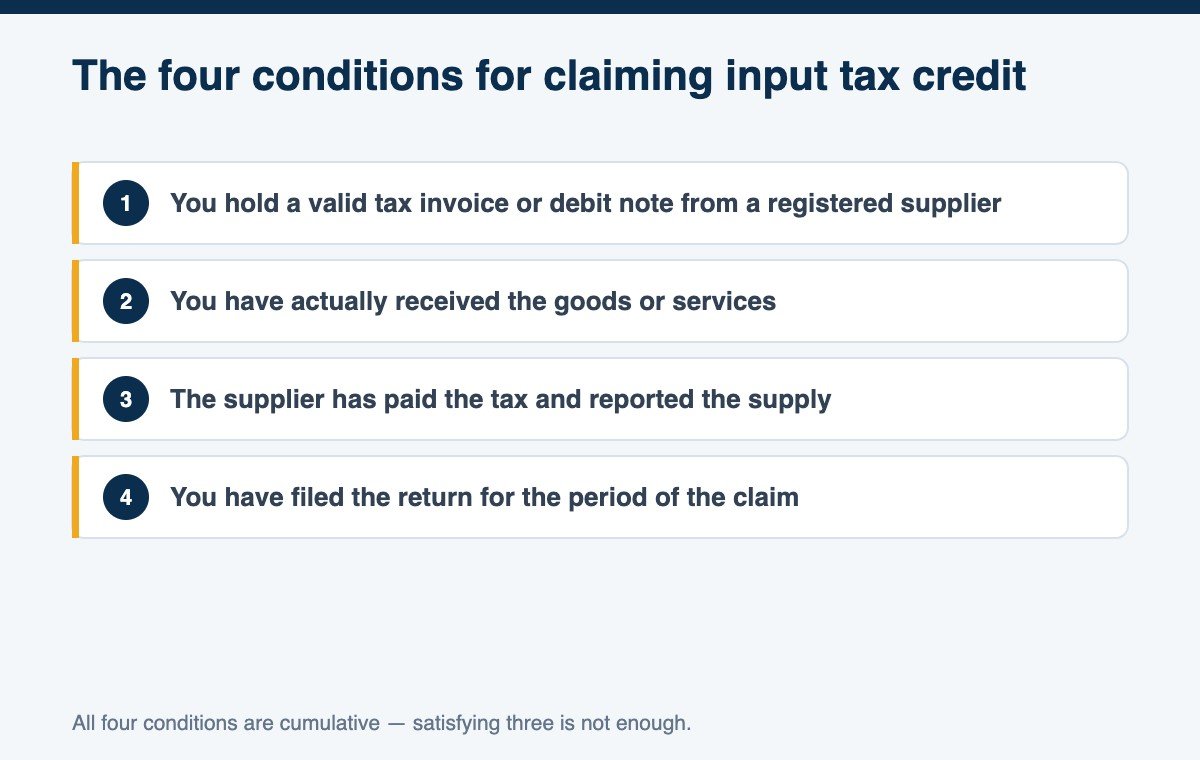
Section 16 of the CGST Act sets out cumulative conditions. All of them must be satisfied — satisfying three out of four is not enough.
- You hold a valid tax invoice or debit note issued by a registered supplier, or another prescribed document such as a bill of entry.
- You have received the goods or services. Where delivery happens in lots, credit is available only on receipt of the last lot.
- The supplier has actually paid the tax to the government and reported the supply, so it appears in your auto-populated statement.
- You have filed the relevant return for the period in which the credit is claimed.
There is also a payment condition: if you do not pay your supplier the invoice value along with tax within the prescribed period, the credit taken has to be reversed with interest and can be reclaimed once payment is made.
Blocked credits under Section 17(5)
Some credits are denied outright regardless of business use. The blocked list broadly covers motor vehicles for passenger transport below a specified seating capacity (with carve-outs where the vehicle is itself the business, such as driving schools and passenger transport operators), food and beverages, outdoor catering, beauty treatment, health services, club and fitness memberships, rent-a-cab and life or health insurance except where an employer is legally obliged to provide them, works contract services for immovable property other than plant and machinery, goods lost, stolen, destroyed or given as free samples, and tax paid under composition or as part of a demand for fraud. Treat this list as the first thing to check when a large credit looks attractive.
When ITC has to be reversed
Reversal is not a penalty — it is the mechanism that keeps credit proportionate to taxable business use. The common triggers are:
- Exempt and non-business use. Where inputs and input services are used partly for taxable supplies and partly for exempt supplies or personal use, credit is apportioned under Rule 42; capital goods follow Rule 43 over their useful life.
- Non-payment to the supplier within the prescribed period.
- Credit notes issued by the supplier, which reduce the credit correspondingly.
- Goods lost, written off, destroyed or disposed of as gifts.
- Cancellation of registration or switching to composition, where credit on stock in hand must be paid back.
Reconciling with GSTR-2B before you claim
Credit is effectively restricted to what your suppliers have reported. GSTR-2B is the static, period-wise statement generated for each recipient, and it is the practical benchmark against which your claim will be tested. Build a monthly habit: download 2B, match it line by line against your purchase register, and split the gaps into invoices your supplier has not filed, invoices with the wrong GSTIN, and invoices you have recorded in a different period. Chase the first category before the filing deadline rather than after. Our guide to GSTR-1 and GSTR-3B filing timelines explains how the two returns feed each other.
Records you should be able to produce
In an audit or scrutiny, the burden of proving eligibility sits with the person claiming the credit. Keep tax invoices and debit notes, proof of receipt such as delivery challans, e-way bills or service acceptance records, proof of payment to the supplier, your reconciliation working between the purchase register and GSTR-2B, and the computation sheet for any Rule 42 or 43 reversal. Reconstructing this two years later is far more expensive than maintaining it monthly.
Mistakes that cost the most
The recurring ones are claiming credit on blocked expenses because the invoice carries GST, claiming provisionally against invoices that never appear in 2B, ignoring apportionment when part of the turnover is exempt, and treating the annual return as the place to fix errors instead of correcting them in the monthly cycle. To sanity-check the tax component on any invoice before you record it, run it through the GST calculator.
Frequently asked questions
Can I claim ITC if my supplier has not filed their GST return?
In practice, no. Credit is tied to the supply appearing in your auto-populated statement, which depends on the supplier reporting it. Follow up with the supplier and, where the amount is material, consider withholding the tax portion of the payment until the invoice is reflected.
Is there a deadline for claiming input tax credit?
Yes — credit for a financial year must be claimed by a cut-off tied to the following year’s return cycle, after which it lapses permanently. Because this date shifts with due-date extensions, confirm the operative deadline for the year you are filing rather than relying on a remembered date.
Can a composition dealer claim ITC?
No. Composition taxpayers pay tax at a concessional rate on turnover and cannot claim input tax credit, and their customers cannot claim credit on purchases from them either. That trade-off is the main reason B2B businesses usually stay out of the scheme.
What happens if I claim ineligible credit by mistake?
Reverse it and pay interest on the amount utilised, ideally before it is flagged. Voluntary correction through the return or a voluntary payment carries a materially better outcome than the same reversal after a departmental notice.
