ITR-5 filing for AY 2026-27 — firms, LLPs and AOPs step-by-step guide
ITR-5 Filing for AY 2026-27 — Firms, LLPs and AOPs Step-by-Step Guide
Introduction
Income-tax return filing for partnership firms, Limited Liability Partnerships (LLPs), Association of Persons (AOPs), Body of Individuals (BOIs) and certain other entities is generally carried out through Form ITR-5.
For Assessment Year (AY) 2026-27, ITR-5 is particularly important because it covers a wide range of non-individual and non-company taxpayers, while the tax system is also undergoing a major transition due to the introduction of the Income-tax Act, 2025 from Tax Year 2026-27.
However, an important distinction must be made:
AY 2026-27 relates to FY 2025-26 and continues to be governed by the Income-tax Act, 1961.
Therefore, taxpayers filing ITR-5 for AY 2026-27 should use the applicable AY 2026-27 forms, schedules and provisions under the existing law.
The Income Tax Department has released the AY 2026-27 ITR-5 utility and related validation framework. The official portal describes ITR-5 as the return applicable to firms, LLPs, AOPs, BOIs and several other specified persons.
This guide explains the complete ITR-5 filing process for AY 2026-27, including applicability, due dates, documents, financial statements, partner details, tax computation, audit requirements, filing procedure and common mistakes.
What is ITR-5?
ITR-5 is the income-tax return form prescribed for certain taxpayers other than individuals, HUFs, companies and persons required to file ITR-7.
The form is primarily used by:
Partnership firms;
LLPs;
AOPs;
BOIs;
Certain Artificial Juridical Persons;
Local authorities;
Co-operative societies;
Certain societies;
Certain trusts not covered by ITR-7;
Estates;
Business trusts;
Investment funds;
Certain representative assessees.
The Income Tax Department specifically lists Firm, LLP, AOP and BOI among the persons for whom ITR-5 is applicable.
Which Entities File ITR-5 for AY 2026-27?
Partnership Firm
A partnership firm registered under the Partnership Act generally files its income-tax return using ITR-5.
This includes firms carrying on:
Trading business;
Manufacturing;
Consultancy;
Professional activities;
Transport business;
Contracting;
Commission business;
Other eligible businesses.
Limited Liability Partnership — LLP
An LLP is treated as a firm for income-tax purposes under the applicable provisions.
Therefore, an LLP generally files ITR-5, rather than ITR-3 or ITR-6.
The Income Tax Department specifically confirms that ITR-5 is applicable to LLPs.
Association of Persons — AOP
An AOP may also be required to file ITR-5 depending upon its nature and applicable provisions.
An AOP is treated as a separate person for income-tax purposes under Section 2(31).
The Income Tax Department confirms that AOPs and BOIs are among the persons eligible to use ITR-5.
Body of Individuals — BOI
A BOI is another category covered by ITR-5.
The exact tax treatment depends upon the constitution of the BOI and the applicable provisions.
Who Should Not Use ITR-5?
ITR-5 should not be used where another specific return form is prescribed.
For example:
Companies
Companies generally file:
ITR-6
subject to the applicable provisions.
Charitable or Religious Trusts
Persons required to file returns under Sections 139(4A), 139(4B), 139(4C) or 139(4D) generally use ITR-7.
The Income Tax Department specifically states that persons required to furnish returns under these provisions should not use ITR-5.
Therefore, selecting the ITR form should always be the first step before starting the return.
AY 2026-27 — Which Financial Year Does It Cover?
AY 2026-27 relates to:
Financial Year 2025-26
Period:
1 April 2025 to 31 March 2026
Therefore, while filing ITR-5 for AY 2026-27, the taxpayer must report:
Income earned during FY 2025-26;
Expenses incurred during FY 2025-26;
Assets and liabilities as applicable;
Partner/member details;
TDS/TCS;
Advance tax;
Other tax information for FY 2025-26.
Important 2026 Transition — Old Act vs New Act
This is one of the most important points for AY 2026-27.
The Income-tax Act, 2025 introduces a new framework from Tax Year 2026-27.
However:
AY 2026-27
relates to:
FY 2025-26
and continues under the:
Income-tax Act, 1961
Therefore, taxpayers should not apply the new Tax Year 2026-27 framework retrospectively while filing AY 2026-27.
In simple terms:
| Particular | AY 2026-27 |
|---|---|
| Financial Year | FY 2025-26 |
| Applicable law | Income-tax Act, 1961 |
| Return | ITR-5 |
| Assessment Year | 2026-27 |
| New Income-tax Act | Not applicable to this FY |
This distinction is especially important for tax professionals handling multiple years simultaneously.
ITR-5 Due Date for AY 2026-27
The due date depends on whether the taxpayer is required to get its accounts audited and whether transfer pricing provisions apply.
Case 1 — Audit Applicable
Where tax audit is applicable, the return filing due date is generally:
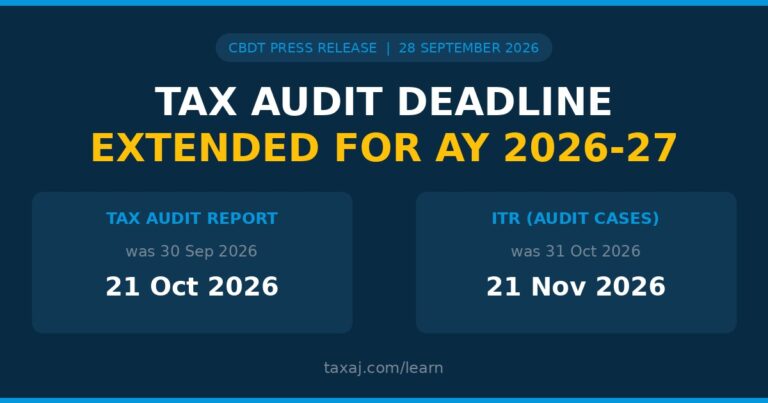
31 October 2026
The audit report is generally required to be furnished before the return due date.
Case 2 — Transfer Pricing Applicable
Where the taxpayer has international transactions or specified domestic transactions requiring transfer pricing compliance, the return due date is generally:
30 November 2026
The applicable transfer pricing report is generally required earlier.
For example:
Form 3CEB — 31 October 2026
and:
ITR — 30 November 2026
subject to applicable law and any extension notified by CBDT.
Case 3 — Audit Not Applicable
Where tax audit is not applicable and the taxpayer falls under the ordinary non-audit category, the applicable return due date is generally:
31 July 2026
The exact due date should always be checked against the latest CBDT notification applicable to the relevant assessment year.
ITR-5 Filing — Complete Step-by-Step Process
Now let’s understand the actual filing process.
Step 1 — Confirm the Correct ITR Form
Before preparing the return, determine:
Entity type;
Nature of income;
Audit applicability;
Transfer pricing applicability;
Exemption status;
Applicable return section.
For a normal partnership firm or LLP carrying on business:
ITR-5 is generally the applicable return.
Step 2 — Collect Basic Entity Details
Keep the following details ready:
PAN;
Legal name;
Trade name, where applicable;
Registered address;
Email ID;
Mobile number;
Date of formation/incorporation;
Date of commencement of business;
Nature of business;
Principal business activity;
Residential status;
Registration details;
Bank account details.
For an LLP, keep:
LLPIN;
Incorporation date;
Registered office;
Partner details.
For a partnership firm:
Firm PAN;
Partnership deed;
Date of constitution;
Partner details;
Profit-sharing ratio.
Step 3 — Verify Partner/Member Details
For partnership firms and LLPs, partner information is extremely important.
The return may require details such as:
Partner name;
PAN;
Aadhaar, where applicable;
Address;
Capital contribution;
Profit-sharing ratio;
Interest paid/credited;
Remuneration paid/credited;
Admission/retirement during the year.
These details should be reconciled with:
Partnership deed;
LLP agreement;
Books of account;
Capital accounts;
Financial statements.
Step 4 — Prepare the Books of Accounts
Before filing ITR-5, the books should be finalized.
Typical books include:
Cash book;
Bank book;
Sales register;
Purchase register;
Journal;
General ledger;
Fixed asset register;
Debtors ledger;
Creditors ledger;
Partner capital accounts;
Loan accounts.
The final trial balance should reconcile with the financial statements.
Step 5 — Prepare Trading and Profit & Loss Account
The next step is preparation of the Profit & Loss Account.
Typical items include:
Revenue
Sales;
Service income;
Commission;
Freight income;
Other operating income.
Direct Expenses
Purchases;
Freight inward;
Manufacturing expenses;
Labour;
Direct wages.
Indirect Expenses
Salary;
Rent;
Electricity;
Telephone;
Professional fees;
Repairs;
Insurance;
Bank charges;
Depreciation;
Interest;
Advertisement;
Other administrative expenses.
The P&L should agree with the books and supporting records.
Step 6 — Prepare Balance Sheet
The Balance Sheet is another important component of ITR-5.
Broadly, it includes:
Assets
Fixed assets;
Investments;
Inventory;
Trade receivables;
Loans and advances;
Cash;
Bank balances;
Other current assets.
Liabilities
Partners’ capital;
Loans;
Trade payables;
Statutory liabilities;
Other current liabilities;
Provisions.
The Balance Sheet should reconcile with the final books.
Step 7 — Reconcile GST Turnover
For GST-registered entities, GST reconciliation is extremely important.
Compare:
Books turnover
with:
GSTR-1 turnover
and:
GSTR-3B turnover
Also consider:
Credit notes;
Debit notes;
Exempt sales;
Nil-rated sales;
Export turnover;
Advances;
Other adjustments.
Any major difference should be explained before filing the income-tax return.
Step 8 — Reconcile TDS and TCS
Download and review:
Form 26AS;
AIS;
TIS, where relevant.
Check:
TDS deducted;
TDS claimed;
TCS;
Advance tax;
Self-assessment tax.
The Income Tax Department confirms that AIS contains information such as TDS/TCS, SFT information, tax payments, refunds and other reported information.
Step 9 — Calculate Depreciation
Book depreciation and income-tax depreciation should be separately considered.
The taxpayer should prepare an income-tax depreciation working based on the applicable provisions.
Important details include:
Opening WDV;
Additions;
Date of acquisition;
Date put to use;
Rate;
Depreciation;
Closing WDV.
Do not simply copy depreciation from the P&L into the tax computation.
Step 10 — Check Partner Remuneration
For partnership firms and LLPs, partner remuneration is an important tax-computation item.
The amount deductible under the Income-tax Act may differ from the amount recorded in the books.
Therefore, calculate allowable remuneration separately.
The partnership deed should properly authorize:
Salary;
Bonus;
Commission;
Remuneration;
Interest to partners.
The deduction is subject to the conditions and limits prescribed under the Income-tax Act, including Section 40(b).
Step 11 — Check Interest on Partner Capital
Interest paid or credited to partners should also be checked.
Important points include:
Partnership deed authorization;
Applicable interest rate;
Book entry;
Deductibility;
Section 40(b) conditions.
Interest should not be claimed merely because it has been credited in the books.
The partnership agreement should support the payment.
Step 12 — Check Disallowances
Before finalizing taxable income, review common disallowances.
These may include:
Disallowance under Section 40(a);
TDS-related disallowances;
Section 40(b) restrictions;
Section 43B items;
Cash payment restrictions under Section 40A(3);
Personal expenses;
Income-tax payments;
Certain penalties;
Other inadmissible expenses.
Step 13 — Check Section 43B Liabilities
Certain expenses are allowable only on actual payment, subject to the applicable provisions.
Therefore, check outstanding:
Statutory dues;
Taxes;
Duties;
Cess;
Certain employee-related contributions;
Interest;
Other specified liabilities.
The exact treatment should be determined based on the relevant statutory provision and applicable payment deadline.
Step 14 — Check Loans and Related-Party Transactions
Review:
Unsecured loans;
Secured loans;
Partner loans;
Related-party balances;
Advances;
Deposits.
Where applicable, tax provisions concerning loans, deposits and related-party transactions should be reviewed separately.
Step 15 — Check Capital Accounts
For partnership firms and LLPs, partner capital accounts should reconcile with:
Opening capital;
Additional capital;
Drawings;
Profit share;
Interest;
Remuneration;
Closing capital.
A common mistake is filing the return with partner capital balances that do not agree with the books.
Step 16 — Determine Taxable Income
After finalizing the P&L and tax adjustments, calculate:
Book Profit
plus:
Disallowances
less:
Allowable deductions
plus/minus:
Other tax adjustments
equals:
Total Taxable Income
The final computation should reconcile with the figures entered in ITR-5.
Tax Rate for Partnership Firm and LLP — AY 2026-27
For AY 2026-27, a partnership firm, including LLP, is generally taxable at:
30%
The Income Tax Department’s AY 2026-27 guidance confirms a 30% tax rate for partnership firms and LLPs.
Surcharge
Where total income exceeds ₹1 crore, surcharge is generally applicable at:
12%
subject to the applicable marginal relief provisions.
Health & Education Cess
Health and Education Cess is generally:
4%
on income tax plus applicable surcharge.
The Income Tax Department’s AY 2026-27 guidance confirms these rates for firms/LLPs.
Alternative Minimum Tax — AMT
Certain partnership firms and LLPs may also need to examine the applicability of Alternative Minimum Tax (AMT).
The Income Tax Department’s AY 2026-27 guidance states that a firm/LLP can be liable to AMT at 18.5% of adjusted total income, plus applicable surcharge and cess, where the normal tax liability is lower than the prescribed AMT liability.
However, AMT applicability depends upon the specific deductions and circumstances of the taxpayer.
Therefore, AMT should be checked separately during tax computation.
AOP Tax Calculation
AOP taxation can be more complicated than taxation of a partnership firm.
The tax rate can depend upon:
Whether shares of members are determinate;
Whether members have other taxable income;
Whether Section 167B applies;
Nature of income;
Special-rate income;
Applicable provisions.
Therefore, an AOP should not blindly apply the 30% firm rate in every case.
The Income Tax Department’s AY 2026-27 guidance separately provides tax-rate rules for AOP/BOI/AJP and notes that their treatment can depend upon applicable conditions.
Does a Firm Have a New Tax Regime Choice?
The individual/HUF new-regime discussion under Section 115BAC should not simply be applied to partnership firms.
A partnership firm/LLP is generally taxed under the separate provisions applicable to firms.
Therefore, while preparing ITR-5, the tax computation should be based on the provisions applicable to the entity rather than treating it like an individual taxpayer.
Audit Requirement for ITR-5
Tax audit applicability should be checked separately.
A firm/LLP may be required to obtain a tax audit report depending upon:
Turnover/gross receipts;
Nature of business;
Presumptive taxation;
Declared profit;
Other applicable conditions.
Where audit is applicable, the taxpayer should complete the audit report before filing the ITR.
Form 3CA/3CD or Form 3CB/3CD
Depending upon the circumstances, the applicable tax audit report may be:
Form 3CA + Form 3CD
or
Form 3CB + Form 3CD
The correct form depends on whether the accounts are required to be audited under another law.
The tax audit information should reconcile with the ITR-5.
Transfer Pricing and ITR-5
Where the firm/LLP/AOP enters into applicable:
International transactions; or
Specified domestic transactions,
transfer pricing provisions may apply.
In such cases, additional compliance such as Form 3CEB may be required.
For AY 2026-27, Form 3CEB continues to apply because the relevant income year is FY 2025-26 under the Income-tax Act, 1961.
Where transfer pricing provisions apply, the return due date is generally later than the ordinary audit return.
ITR-5 Schedules — Important Areas
ITR-5 is a comprehensive return and contains numerous schedules.
Depending upon the entity’s circumstances, important areas may include:
Part A — General
Contains basic information about:
Entity;
PAN;
Address;
Status;
Business activity;
Filing details.
Part A — Balance Sheet
Reports:
Capital;
Reserves;
Loans;
Assets;
Current liabilities;
Other financial information.
Profit & Loss Account
Contains:
Revenue;
Expenses;
Profit/loss;
Financial statement information.
Depreciation Schedule
Used for income-tax depreciation computation.
Schedule BP
Computes income from business or profession after tax adjustments.
Schedule DPM/DOA
Relevant depreciation computations depending upon the nature of assets and applicable provisions.
Schedule CG
Required where the entity has capital gains.
Schedule OS
For income from other sources.
Schedule CYLA/BFLA
Relevant for adjustment of current-year and brought-forward losses, where applicable.
Schedule CFL
Used for losses to be carried forward.
Schedule TDS/TCS
Reports tax deducted or collected.
Schedule IT
Reports advance tax and self-assessment tax payments.
Partner/Member Information
For firms, LLPs and AOPs, partner/member-related details are particularly important.
Not every schedule is applicable to every taxpayer. The return should be populated based on the actual facts of the entity.
Documents Required for ITR-5 Filing
A professional ITR-5 filing generally requires the following information.
Entity Documents
PAN;
Partnership deed/LLP agreement;
LLP incorporation documents;
Registration certificate;
Previous ITR acknowledgement;
Previous computation.
Financial Documents
Trial balance;
Profit & Loss Account;
Balance Sheet;
General ledger;
Cash book;
Bank statements;
Fixed asset details;
Debtors list;
Creditors list.
Tax Documents
Form 26AS;
AIS;
TIS;
TDS certificates;
TCS certificates;
Advance tax challans;
Self-assessment tax challans.
GST Documents
Where applicable:
GSTR-1;
GSTR-3B;
Annual return;
GST turnover reconciliation;
Electronic liability/credit ledger information.
Other Documents
Depending upon the entity:
Loan statements;
Interest certificates;
Capital gains statements;
Investment statements;
Property documents;
Foreign transaction details;
Related-party transaction details.
ITR-5 Filing on Income Tax Portal
The return can be prepared using the applicable online/offline utility released by the Income Tax Department.
The official Income Tax portal provides an ITR-5 utility and schema for AY 2026-27.
The broad workflow is:
Step 1
Login to the Income Tax e-Filing portal.
Step 2
Select:
e-File → Income Tax Returns → File Income Tax Return
Step 3
Select:
Assessment Year 2026-27
Step 4
Select the applicable filing mode.
Step 5
Select:
ITR-5
Step 6
Enter/pre-fill entity details.
Step 7
Complete the applicable schedules.
Step 8
Enter financial information.
Step 9
Enter partner/member details.
Step 10
Enter tax details.
Step 11
Validate the return.
Step 12
Resolve validation errors.
Step 13
Submit the return.
Step 14
Verify the return through the applicable verification method.
DSC Verification for Firms and LLPs
The return verification process is particularly important for firms and LLPs.
Where digital signature verification is required, the authorized person should have:
Valid DSC;
DSC registered on the e-Filing portal;
Correct authorized capacity.
The taxpayer should ensure that the person signing/verifying the return is properly authorized.
For an LLP, the authorized partner should be correctly reflected in the portal records.
Common ITR-5 Validation Errors
The AY 2026-27 ITR-5 validation framework contains entity-specific validations.
For example, the CBDT’s AY 2026-27 validation rules include checks relating to:
AOP sub-status;
Section 115BAD option;
LLP/partnership sub-status;
Date of commencement of business;
Date of incorporation;
Partner-related information.
The validation rules state, among other things, that the date of commencement of business should not precede incorporation and should not fall after the end of the financial year.
This means users should not simply enter approximate dates to complete the return.
Common Mistakes While Filing ITR-5
Wrong ITR Form
Using ITR-4 instead of ITR-5 for an LLP is a common mistake.
ITR-4 is available only to eligible individuals, HUFs and resident firms other than LLP subject to its conditions.
Wrong Assessment Year
For income earned from:
1 April 2025 to 31 March 2026
select:
AY 2026-27
Mismatch Between P&L and ITR
The P&L uploaded/maintained in accounts should reconcile with the figures reported in ITR-5.
Incorrect Partner Remuneration
Partner remuneration should be checked against:
Partnership deed;
Books;
Section 40(b);
Tax computation.
Incorrect Capital Balances
Partner capital accounts should reconcile with the Balance Sheet.
Ignoring TDS
TDS appearing in 26AS/AIS should be reconciled before claiming credit.
GST Turnover Mismatch
Income-tax turnover and GST turnover should be reconciled and differences documented.
Wrong Depreciation
Book depreciation should not automatically be treated as income-tax depreciation.
Ignoring Brought-Forward Losses
Previous-year losses should be checked against earlier ITR acknowledgements and tax records.
Incorrect Bank Details
Bank accounts should be properly reported and validated on the portal.
Not Filing Audit Report
Where tax audit is applicable, the relevant audit report should be completed within the applicable timeline.
Ignoring AMT
Eligible deductions can trigger AMT implications. This should be checked before finalizing the tax computation.
ITR-5 Reconciliation Checklist
Before submitting the return, perform the following reconciliation:
Books vs ITR
Turnover
Purchases
Expenses
Net profit
Fixed assets
Loans
Capital
GST vs Books
Taxable sales
Exempt sales
Export sales
Credit notes
Debit notes
Total turnover
AIS/26AS vs Books
TDS
TCS
Interest
Other reported income
Partner Accounts vs ITR
Capital
Profit share
Remuneration
Interest
Drawings
Tax Payments vs ITR
Advance tax
Self-assessment tax
TDS
TCS
Practical Example — Partnership Firm
Suppose ABC Enterprises is a partnership firm.
For FY 2025-26:
Sales: ₹2 crore
Other income: ₹5 lakh
Total expenses: ₹1.70 crore
Book profit: ₹35 lakh
Partner remuneration:
₹8 lakh
Partner interest:
₹2 lakh
The tax computation should not simply be:
₹35 lakh × 30%
The taxpayer must first examine:
Whether remuneration is allowable;
Whether interest is allowable;
Whether any expense requires disallowance;
Depreciation adjustment;
Section 43B items;
Other tax adjustments;
AMT, if applicable.
After arriving at taxable income, the applicable firm tax rate is applied.
Practical Example — LLP
Suppose XYZ LLP has:
Business turnover: ₹5 crore
Net profit as per books: ₹60 lakh
Depreciation as per books: ₹10 lakh
Income-tax depreciation: ₹7 lakh
Disallowable expenses: ₹3 lakh
A simplified tax adjustment could be:
Book profit
₹60 lakh
Add back book depreciation
₹10 lakh
Less tax depreciation
₹7 lakh
Add disallowable expenses
₹3 lakh
Taxable business income before other adjustments:
₹66 lakh
This is only an illustrative example. Actual tax computation depends on all applicable provisions and schedules.
What Should Be Checked Before Final Submission?
A professional review should cover:
Entity
Correct PAN;
Correct legal name;
Correct constitution;
Correct date of incorporation/formation.
Financials
Balance Sheet tallies;
P&L tallies;
Capital accounts reconcile;
Bank balances reconcile.
Tax
TDS matched;
TCS matched;
Advance tax matched;
Self-assessment tax checked.
Compliance
Audit report filed;
Transfer pricing report filed, where applicable;
Correct ITR selected;
Correct assessment year selected;
Correct verification completed.
ITR-5 AY 2026-27 — Professional Filing Workflow
For professional tax practitioners, the following workflow is recommended:
Step 1: Collect previous-year ITR and computation
↓
Step 2: Finalize books
↓
Step 3: Prepare financial statements
↓
Step 4: Reconcile GST
↓
Step 5: Reconcile AIS/26AS
↓
Step 6: Calculate depreciation
↓
Step 7: Check disallowances
↓
Step 8: Calculate partner remuneration/interest
↓
Step 9: Check audit applicability
↓
Step 10: Check transfer pricing applicability
↓
Step 11: Prepare tax computation
↓
Step 12: Fill ITR-5
↓
Step 13: Validate all schedules
↓
Step 14: Pay tax, if any
↓
Step 15: Submit ITR
↓
Step 16: Complete verification
↓
Step 17: Save acknowledgement and computation
ITR-5 AY 2026-27 — Important Dates at a Glance
| Particular | AY 2026-27 |
|---|---|
| Relevant FY | FY 2025-26 |
| ITR Form | ITR-5 |
| Main taxpayers | Firms, LLPs, AOPs, BOIs and other specified persons |
| Audit case return due date | Generally 31 October 2026 |
| Transfer pricing case return due date | Generally 30 November 2026 |
| Non-audit case | Generally 31 July 2026 |
| Relevant law | Income-tax Act, 1961 |
| Tax rate for Firm/LLP | Generally 30% |
| Surcharge above ₹1 crore | Generally 12% |
| Health & Education Cess | 4% |
| AMT for applicable Firm/LLP | 18.5% of adjusted total income, subject to conditions |
Note: Due dates can be changed or extended by CBDT through subsequent notifications. Always verify the latest notification before filing.
Frequently Asked Questions
Who files ITR-5?
ITR-5 is used by firms, LLPs, AOPs, BOIs and various other specified entities.
Can an LLP file ITR-4?
No. ITR-4 is not the normal return form for an LLP. Eligible firms other than LLP may use ITR-4 subject to its conditions, whereas LLPs generally file ITR-5.
What is the tax rate for LLP for AY 2026-27?
A partnership firm, including LLP, is generally taxed at 30%, subject to applicable surcharge and cess.
Is audit mandatory for every partnership firm?
No. Audit applicability depends upon the relevant statutory conditions. Turnover, presumptive taxation and other circumstances should be examined.
Can an AOP file ITR-5?
Yes, ITR-5 is applicable to AOPs subject to the applicable provisions.
What is the difference between ITR-5 and ITR-7?
ITR-5 covers firms, LLPs, AOPs, BOIs and other specified persons, while ITR-7 applies to persons required to file returns under specified provisions such as Sections 139(4A) to 139(4D).
Is Form 3CEB required with ITR-5?
Not for every ITR-5 filer. It becomes relevant where the taxpayer has applicable international transactions or specified domestic transactions under the transfer pricing provisions.
Is the new Income-tax Act applicable to AY 2026-27?
No. AY 2026-27 relates to FY 2025-26 and continues under the Income-tax Act, 1961. The new framework applies from Tax Year 2026-27.
Can ITR-5 be filed online?
Yes. The Income Tax Department provides online filing and utilities for ITR-5. The AY 2026-27 ITR-5 utility and schema are available on the official portal.
What should be checked before filing?
At minimum:
Books;
Financial statements;
GST reconciliation;
AIS/26AS;
TDS/TCS;
Partner accounts;
Depreciation;
Disallowances;
Audit;
Transfer pricing;
Tax payments.
Conclusion
ITR-5 filing for AY 2026-27 requires much more than simply entering the Profit & Loss Account and Balance Sheet.
For firms, LLPs and AOPs, the return should be prepared only after properly reviewing the entity’s constitution, financial statements, partner/member details, tax adjustments, TDS/TCS, GST turnover, depreciation, audit requirements and other applicable provisions.
For FY 2025-26 / AY 2026-27, taxpayers should also remember that the return continues to fall under the Income-tax Act, 1961, despite the introduction of the new Income-tax Act, 2025 for the subsequent Tax Year.
The Income Tax Department’s current AY 2026-27 resources confirm that ITR-5 is the applicable return for firms, LLPs, AOPs, BOIs and other specified persons, and the Department has also released the corresponding ITR-5 utility and validation rules.
A properly prepared ITR-5 should therefore follow a structured process:
Finalize Books → Prepare Financial Statements → Reconcile GST → Reconcile AIS/26AS → Calculate Tax Adjustments → Check Audit/TP → Prepare ITR-5 → Validate → File → Verify → Preserve Acknowledgement.
Proper reconciliation before filing is particularly important because mismatches between books, GST returns, AIS, TDS statements and the income-tax return can result in unnecessary notices or clarification requirements.

Sandeep Roy is an Accounts Executive in TAXAJ's Accounts & Taxation team. With over six years of industry experience, Sandeep handles bookkeeping, tax filings and day-to-day compliance for clients. TAXAJ is a multi-disciplinary consulting firm spanning finance, taxation, legal, secretarial, FEMA and IPR, with offices in Delhi, Bihar, Bangalore and Goa.
View all posts by Sandeep Roy →