
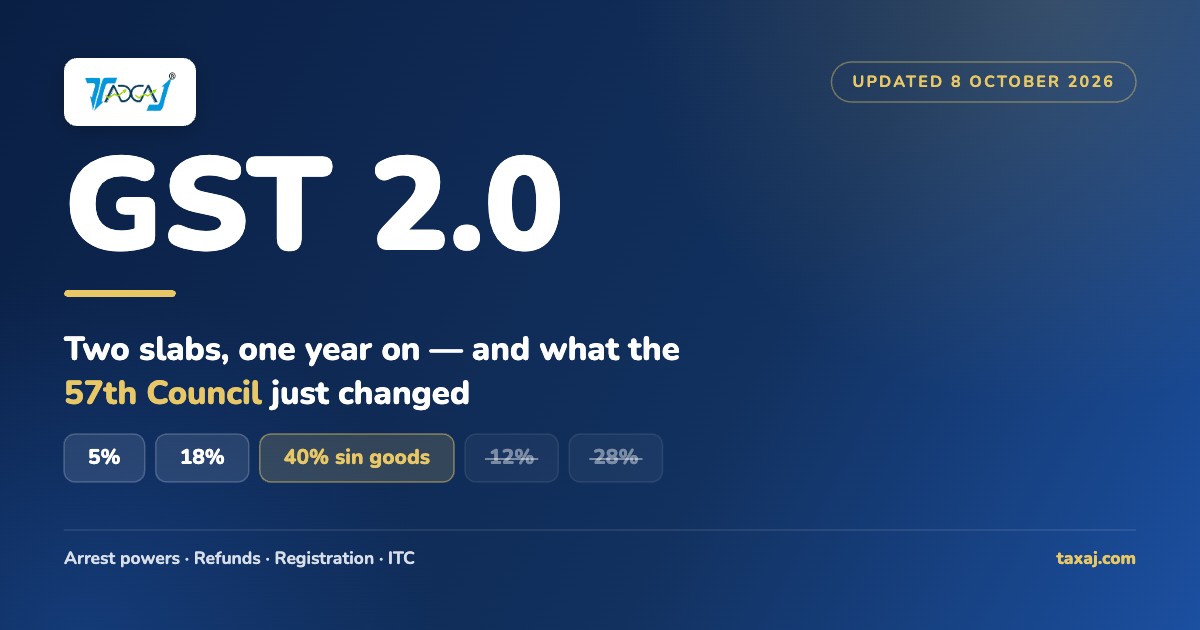
GST 2.0 — New Slabs, Rates and the 57th Council Reforms
The GST Council met on 7 and 8 October 2026 and left the rates alone. What it went after instead was the machinery — the power of arrest, the prosecution threshold, refund timelines, registration, and the small notices that cost more to answer than they collect. Thirteen months after GST 2.0 collapsed four slabs into two, this is the second half of the reform.
Here is where GST 2.0 actually stands today: what the two-slab structure changed, what it did to revenue over a full year, and what the 57th Council has just recommended.
What the 57th GST Council decided
The meeting ran over two days and concluded on 8 October 2026. Finance Minister Nirmala Sitharaman said afterwards that “99% of the issues have been addressed”. There were no rate changes, and rate rationalisation will now be taken up at one dedicated meeting a year rather than item by item.
The power of arrest is to be removed
The Council recommended omitting Section 69 of the CGST Act entirely — the provision allowing a Commissioner to authorise arrest. Alongside it, the prosecution threshold rises from ₹1 crore to ₹5 crore of tax evaded, mandatory minimum punishments go, and several limbs of Section 132 are narrowed or deleted. For a genuine business caught in a dispute, this is the most consequential item in the package.
Refunds get deadlines that mean something
- Acknowledgement within 10 days instead of 15, with deemed acknowledgement if the department misses it
- 90% provisional sanction for zero-rated and inverted-duty claims, targeted within three working days of acknowledgement
- Automatic full refund of excess electronic cash ledger balance
- The Rule 89(4)(C) cap on zero-rated turnover — previously 1.5 times the domestic like-goods value — is removed
- The ₹1,000 refund threshold under Section 54(14) to apply to the total across CGST, SGST/UTGST and IGST rather than each separately
No more trivial notices
A minimum of ₹10,000 (CGST + SGST + IGST + cess) before a show-cause notice can issue under Sections 73, 74 or 74A — and pending notices below that figure are to be decided as though the threshold had always applied. The maximum general penalty under Section 125 falls from ₹25,000 to ₹10,000, and the ₹10,000 minimum penalty in non-fraud cases is removed. Pre-deposit for penalty-only appeals is to be capped at ₹40 crore.
Registration and amendments go automatic
Low-risk applicants, and those passing on output tax of up to ₹2.5 lakh a month to registered buyers, get registration within three working days with no officer involvement. Routine amendments — trade name, directors or partners, additional places of business — are accepted automatically. Only a change of principal place of business and cancellation stay manual. A new Rule 14B covers small e-commerce sellers using a warehouse as their principal place of business.
Input tax credit — real relief, and two exclusions
Section 17(5), the blocked-credit provision every finance team has argued with, is being opened up. The Council recommended allowing ITC on outdoor catering, employee health and life insurance, telecom towers, pipelines laid outside factory premises, free samples, and goods destroyed or written off because the law requires disposal at shelf-life expiry.
Two refund timings were fixed precisely:
- 1 November 2026 — accumulated ITC on input services under an inverted duty structure becomes refundable, for credit availed on or after that date. This matters most to FMCG and pharma.
- 1 April 2027 — the bar on refunding ITC on capital goods goes, with the refund spread over 60 months, for credit availed on or after that date.
A correction worth making, because the reporting has been loose. Several summaries say “Section 17(5) was deferred”. That is not what happened. What went to a committee of officers was narrower: ITC on motor vehicles seating 13 or more, which is one sub-item inside Section 17(5), and separately Section 16(2)(c) — the proposal to stop penalising an honest buyer when a supplier fails to pay. The Council could not resolve the fake-invoicing risk on that one. The committee reports within three months, and implementation, if it comes, is being discussed for 1 April 2027.
If you were counting on Section 16(2)(c) relief for a live dispute, it has not arrived. Supplier due diligence and GSTR-2B reconciliation matter exactly as much this week as they did last week.
None of this is law yet. These are Council recommendations. They take effect only through CBIC notifications, circulars and — for arrest, prosecution, penalties and the ITC changes — amendments to the CGST Act. Until each is notified, the existing provision applies. Do not change a filing position, withdraw an appeal or drop a pre-deposit on the strength of a press report.
Also announced: a faceless assessment scheme for Central GST taxpayers, in-principle approval of an optional annual-return-with-quarterly-payment scheme for businesses under ₹5 crore turnover supplying only to consumers, and a target of processing 90% of returns within 13 days of filing. E-invoicing is to extend to reverse-charge supplies from unregistered persons and to imported services, for taxpayers at ₹5 crore turnover and above.
What GST 2.0 did in September 2025
The 56th Council met on 3 and 4 September 2025 and approved a package effective 22 September 2025. The headline was structural: the 12% and 28% slabs were removed, leaving 5% and 18%, with a new 40% rate for luxury and sin goods.
| Before 22 Sep 2025 | After | What moved |
|---|---|---|
| 5% | 5% | Retained as the merit rate, and widened considerably |
| 12% | Removed | Mostly down to 5% or Nil, a few items up to 18% |
| 18% | 18% | Retained as the standard rate |
| 28% | Removed | Most goods to 18%; luxury and sin goods to 40% |
| — | 40% (new) | Pan masala, tobacco, aerated drinks, high-end cars, yachts, private aircraft |
Three things were being attempted at once: cut the household tax burden, fix the inverted duty structures trapping working capital in textiles and fertilisers, and reduce the classification disputes that four slabs had generated.
The rate changes, sector by sector
These are the rates notified with effect from 22 September 2025. If you are reconciling a period before that date, the old rates apply to it.
| Item | Was | Now |
|---|---|---|
| Food and household | ||
| UHT milk, pre-packaged chena and paneer, all Indian breads | 5% | Nil |
| Soaps, shampoos, toothbrushes, toothpaste, tableware, bicycles | 12% / 18% | 5% |
| Packaged namkeens, bhujia, sauces, pasta, chocolates, coffee, preserved meat | 12% / 18% | 5% |
| TVs above 32 inches (LCD/LED), air conditioners, dishwashers | 28% | 18% |
| Housing and construction | ||
| Cement | 28% | 18% |
| Marble and travertine blocks, granite blocks, sand-lime bricks | 12% | 5% |
| Bamboo flooring and joinery, wooden packing cases and pallets | 12% | 5% |
| Automobiles | ||
| Small cars, two-wheelers up to 350cc | 28% | 18% |
| Buses, trucks, three-wheelers, all auto parts | 28% | 18% |
| Agriculture | ||
| Tractors | 12% | 5% |
| Tractor tyres and parts | 18% | 5% |
| Harvesters, threshers, sprinklers, drip irrigation, poultry and bee-keeping machines | 12% | 5% |
| Bio-pesticides, natural menthol | 12% | 5% |
| Healthcare and insurance | ||
| 33 specified life-saving drugs and diagnostic kits | 12% | Nil |
| Other medicines, including Ayurveda, Unani and Homoeopathy | 12% | 5% |
| Spectacles and corrective goggles | 28% | 5% |
| Medical oxygen, thermometers, surgical instruments | 12–18% | 5% |
| Medical, dental and veterinary devices | 18% | 5% |
| Individual life and health insurance premiums, floater and senior citizen policies | 18% | Exempt |
| Services | ||
| Hotel stays up to ₹7,500 per day | 12% | 5% |
| Gyms, salons, barbers, yoga | 18% | 5% |
| Textiles, handicrafts and education | ||
| Man-made fibre | 18% | 5% |
| Man-made yarn | 12% | 5% |
| Handicraft idols and statues, paintings, sculptures, dolls and toys | 12% | 5% |
| Exercise books, erasers, pencils, crayons, sharpeners, maps, atlases | 12% | Nil |
| Geometry boxes, school cartons, trays | 12% | 5% |
The carve-out that landed in February 2026
When the 40% rate was announced, tobacco was held back. Cigarettes, chewing tobacco such as zarda, unmanufactured tobacco and beedi stayed on their old GST and compensation cess rates, because the cess was still servicing the loans raised to compensate states during the pandemic. The new rate was to come “at a later date to be notified”.
That date was 1 February 2026. From then, tobacco and pan masala moved to the 40% GST rate, the compensation cess was discontinued on these goods, and two new levies replaced it — an additional excise duty on tobacco products and a Health and National Security Cess on pan masala, both enacted through Bills passed in December 2025. Beedi was treated separately and attracts 18%.
The structure changed, not only the percentage. Compensation cess was a GST levy shared under the GST framework; excise duty is a central levy. If you deal in these goods, your classification and your credit position both moved.
Did the rate cuts cost the government money?
This was the open question in September 2025, and for the first six months the honest answer was yes. Gross collection growth fell from 9.1% in September 2025 to 4.6% in October, then turned negative at −3.9% in November 2025. It stayed subdued into early 2026 and only accelerated from June.
It has since recovered. September 2026 gross GST was ₹2,03,521 crore, up 14.7% year on year, with net collections of ₹1,76,520 crore, up 18.1%. For the first half of FY27, gross collections were ₹12.46 lakh crore, up 11.6%.
But read the composition, not the headline. The recovery is carried by imports. In September 2026 import-linked GST rose 25.9% while domestic GST rose 10.1%. Over the twelve months to August 2026, domestic GST was roughly 1% lower than the preceding year, while import-linked GST was almost 20% higher. Refunds also rose about 20.6% over that period, taking their share of gross collections from around 12.1% to 13.7% and holding back net growth.
So the structure survived, and the claim that rate rationalisation did not damage revenue holds at the aggregate level. Domestic consumption-linked GST, though, has been close to flat. Anyone modelling their own sector off the national headline will get it wrong.
What to actually do about it
- If you have refunds stuck: the 90% provisional sanction and the 10-day acknowledgement are not live until notified. But the inverted duty refund on input services starts accruing from 1 November 2026, and credit availed before that date does not qualify — so the timing of purchases this month genuinely matters.
- If you are in a dispute: review what is pending against you below ₹10,000, because those are to be decided as though the threshold always applied. The general penalty cap dropping to ₹10,000 changes the arithmetic on whether to contest. Do not act on arrest or prosecution relief until the amendment is notified.
- If you are capital-investing: ITC on capital goods becomes refundable for credit availed on or after 1 April 2027, spread over 60 months. That is a real reason to review the phasing of a large plant or machinery purchase.
- If you are small or newly registering: three-working-day registration and automatic routine amendments should remove a familiar source of delay. The optional annual-return scheme for B2C-only businesses under ₹5 crore is approved in principle but not operational.
The dates that matter
| Date | What happens | Status |
|---|---|---|
| 22 September 2025 | Two-slab structure and the rate cuts take effect | In force |
| 1 February 2026 | Tobacco and pan masala to 40% GST; cess replaced by excise duty and health cess | In force |
| 7–8 October 2026 | 57th Council recommends the compliance package | Recommended |
| 1 November 2026 | Inverted-duty refund on ITC of input services, for credit availed on or after this date | Awaiting notification |
| By early January 2027 | Committee reports on Section 16(2)(c) and ITC on 13-seater-plus vehicles | Pending |
| 1 April 2027 | Capital goods ITC refund over 60 months, for credit availed on or after this date | Awaiting notification |
| April 2027 return | Revised GSTR-3B and GSTR-1 reconciliation mechanism, after public consultation | Proposed |
Frequently asked questions
How many GST slabs are there now?
Two main rates, 5% and 18%, plus a 40% rate for luxury and sin goods and a Nil category. The 12% and 28% slabs were removed with effect from 22 September 2025.
Has the GST arrest power actually been removed?
Not yet. The 57th Council recommended omitting Section 69 of the CGST Act and raising the prosecution threshold from ₹1 crore to ₹5 crore. Both need an amendment to the Act. Until that is passed and notified, the existing powers remain.
Were the September 2025 rate cuts rolled back after the revenue drop?
No. Collections did fall, with growth turning negative at −3.9% in November 2025, but no rate was reversed. The 57th Council made no rate changes at all.
Is Section 17(5) being scrapped?
No, and this has been widely misreported. The Council recommended unblocking ITC on specific items within Section 17(5) — outdoor catering, employee health and life insurance, telecom towers, pipelines outside factory premises, free samples, and goods the law requires to be destroyed at shelf-life expiry. One sub-item, ITC on motor vehicles seating 13 or more, was deferred to a committee. The section itself stays.
Will I get ITC if my supplier does not pay the tax?
Still no. The proposal to soften Section 16(2)(c) was deferred at the 57th Council over fake-invoicing concerns and sent to a committee reporting within three months. Implementation, if it comes, is being discussed for 1 April 2027.
Is individual health insurance GST-free now?
Yes. GST on premiums for individual life insurance, health insurance, floater plans and senior citizen policies was exempted from 22 September 2025, down from 18%. This covers individual policies; group and corporate arrangements follow their own treatment.
Does any of this change what I file this month?
No. Nothing recommended on 7–8 October 2026 is in force yet. Your current returns, rates and refund process are unchanged until the relevant notification or amendment issues. The one thing worth acting on now is timing, because the 1 November 2026 input-services refund applies only to credit availed on or after that date.
Need help working out what applies to you?
TAXAJ files GST returns and handles GST litigation for businesses across Delhi, Bengaluru, Goa and Bihar. On this package, the work that pays for itself in the next six months is unglamorous: checking which pending notices fall under the new ₹10,000 threshold, re-running your inverted duty position against the 1 November date, and reconciling GSTR-2B properly now that Section 16(2)(c) relief has not arrived.
Last updated 8 October 2026. Rates described as in force are those notified to date. Everything attributed to the 57th GST Council is a recommendation and is not law until the corresponding CBIC notification, circular or CGST Act amendment is issued. This is general information, not advice on any particular case, and it will be updated as the notifications are published.
